Assignment 4 Critical Review of Towards Los Angeles by Dorothea Lange Rewrite.

Looking at “Towards Los Angeles” (Lange, 1937) has taken me on a journey. This journey had a starting point just enjoying Dorothea Lange’s photograph. Stops along the way included the New Deal, Roy Stryker and his methods of work. Jack Delano writes “Through these travels and the photographs I got to love the United States more than I could have in any other way” (Delano, 1942). My journey ends with an understanding of the catalyst that created this body of work.

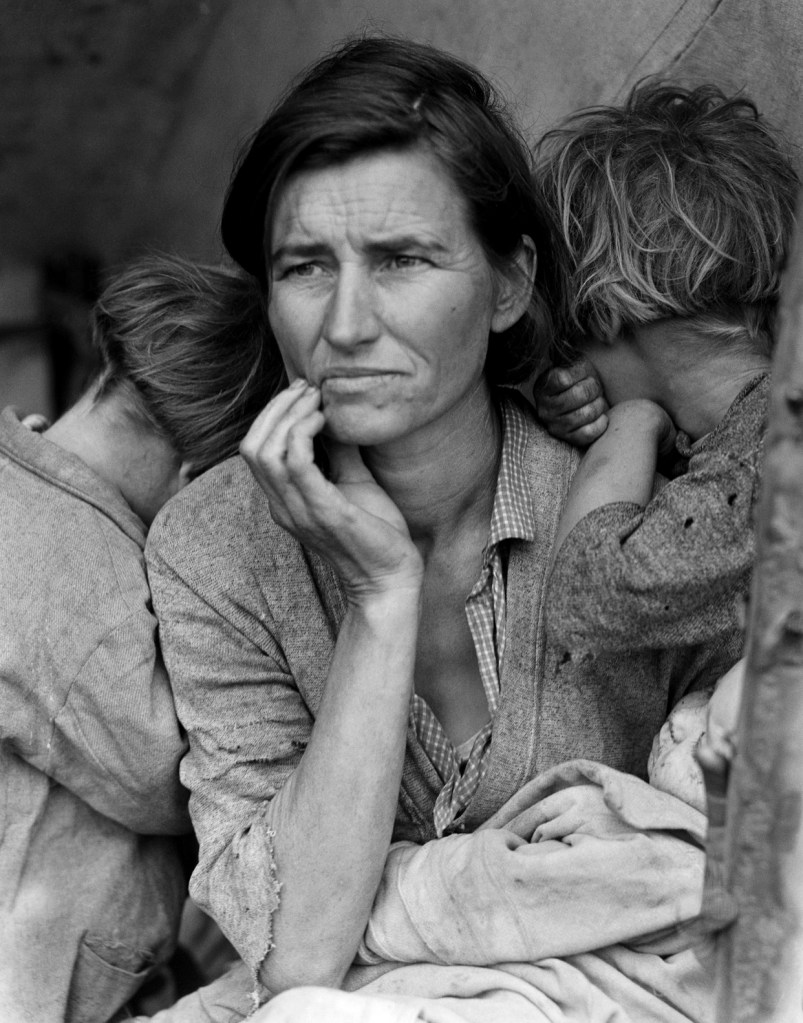
I chose to review this photograph partly because it doesn’t show female subjects in a matriarchal role. Dorothea Lange was unfairly called the “Mother” of the group of photographers within the Farm Security Administration. Dorothea Lange was given this title as she showed mothers in a lot of her photographs. I disagree she showed strong female icons who were struggling to hold together their families. Florence Owens Thompson the primary subject in “Migrant Mother”, had just sold the tires from her car to put food on her children’s table. This was a lady doing whatever to keep her family intact and to my interpretation the use of ‘Mother’ is intended to reduce and oversimplify the importance of her role

.
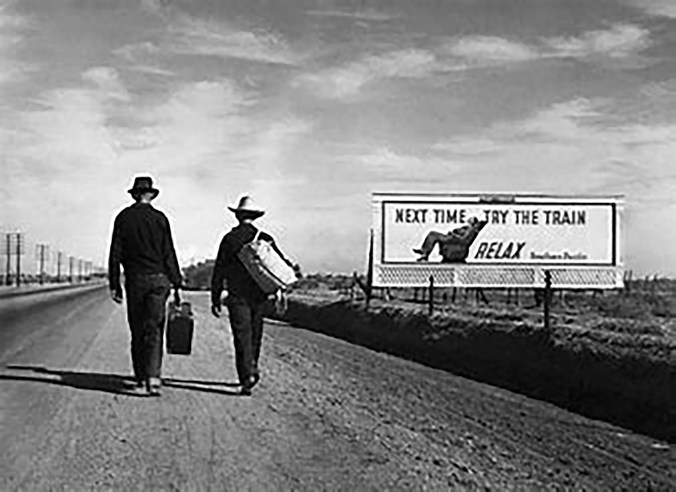
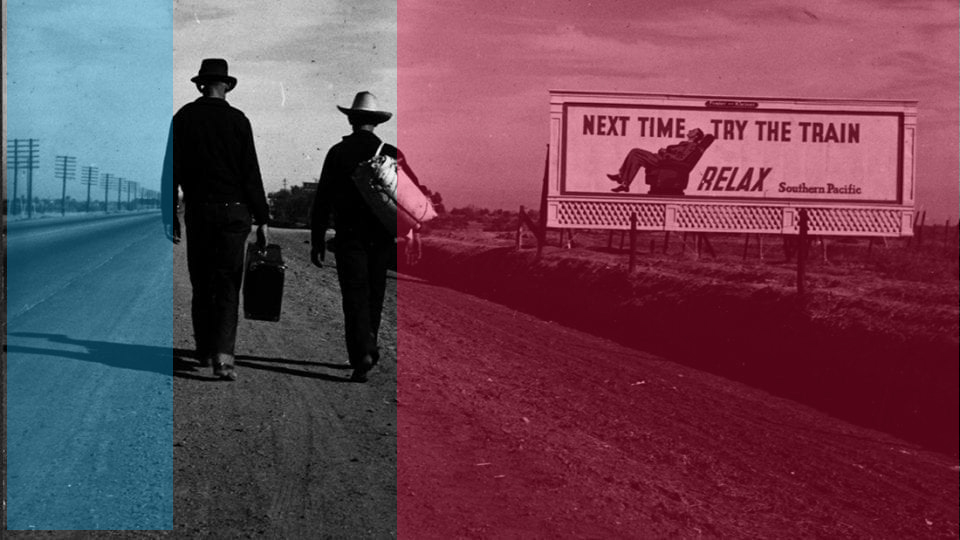
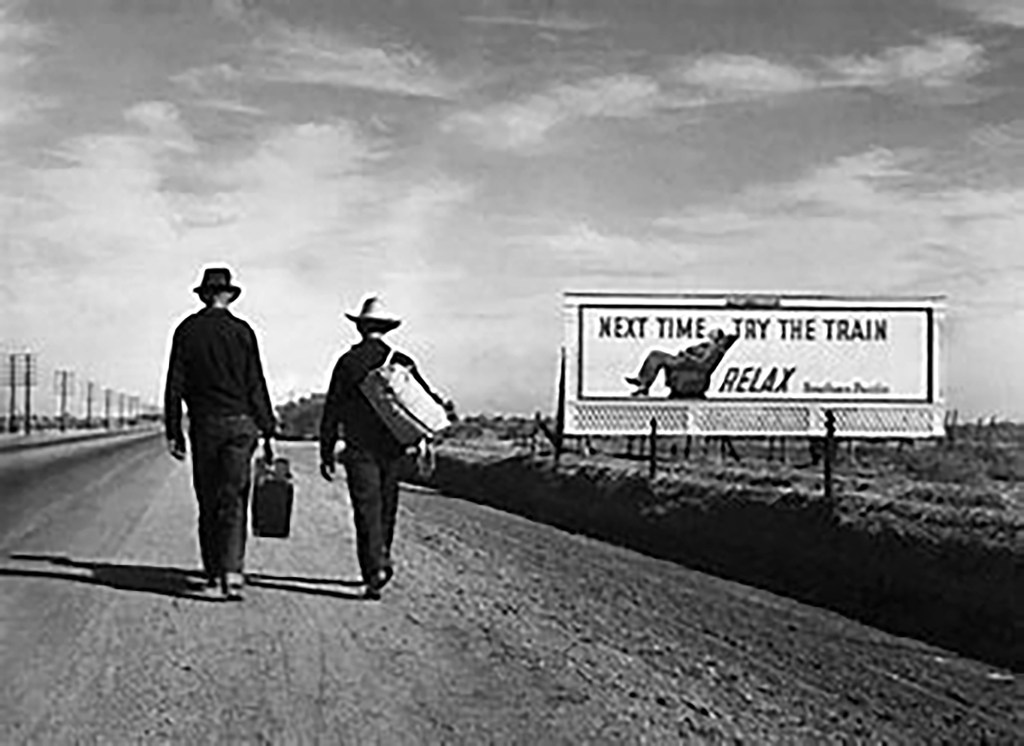
Looking at “Towards Los Angeles” I see two men travelling along a dusty road past a billboard which shows the advertising slogan “Next time try the train……..Relax”. Both men look like they couldn’t afford to take the train. They are walking a dusty road Highway 99 through a dark verge and a line of telegraph poles which form strong leading lines emphasising the distance travelled and the way to go to reach their destination. They are carrying their luggage by hand. Both wear hats shielding them from the sun hinted at with brown necks. The boot of the man on the right is raised making me feel it is a “decisive moment” in the style of Henri Cartier Bresson. Bresson’s photo “Behind the Gare Saint Lazare” (Bresson, 1932) shows the decisive moment of a man leaping across a puddle. The man’s foot is above the water separating him from the physical world it hints at movement in the instant. Neither of the men in Towards Los Angeles appears to be taking any notice of the billboard the punch line of the photograph. As I study this photograph I begin to wonder if it was staged.

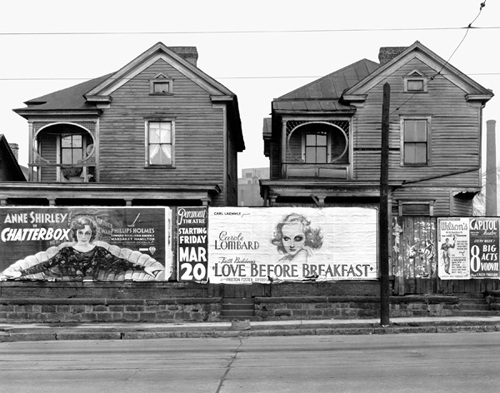
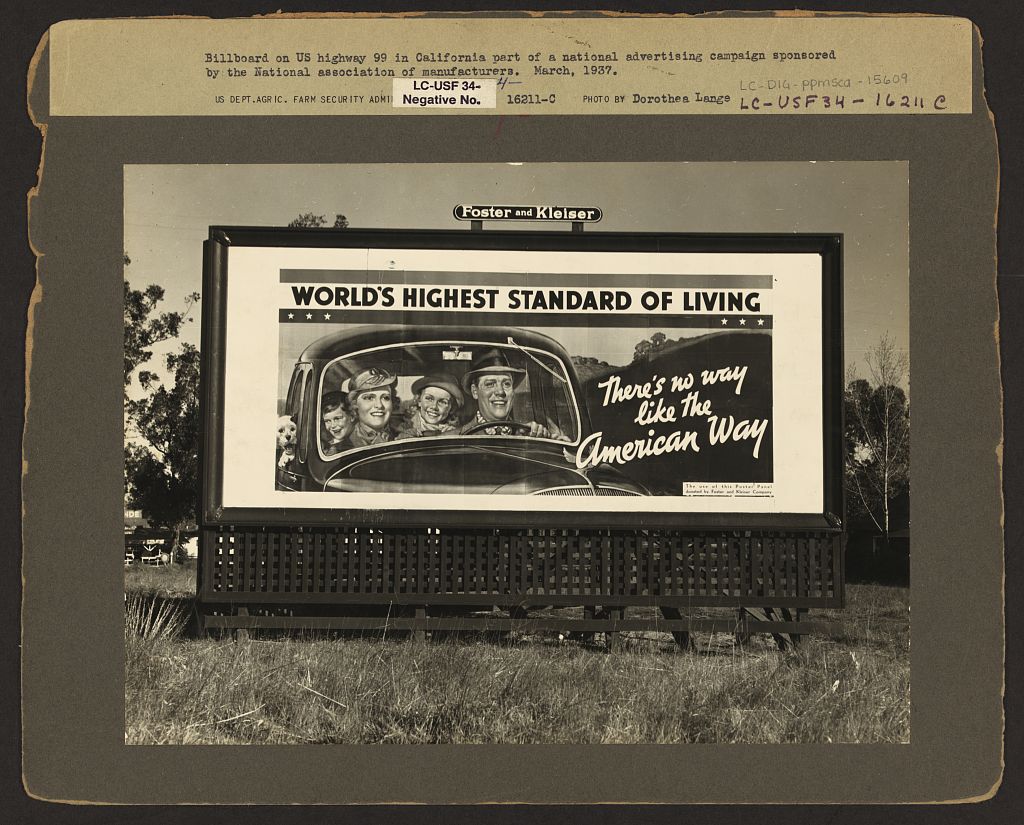
Why include a Billboard? In February 1936 Walker Evans had taken “Framed houses and a billboard” (Evans 1936) followed a year later by Edwin Locke who took “Road sign near Kingwood, West Virginia”, (Locke, 1937).  Lange took similar images along route 99 and would have been aware of all of the images taken by Evans and Locke as they were colleagues.

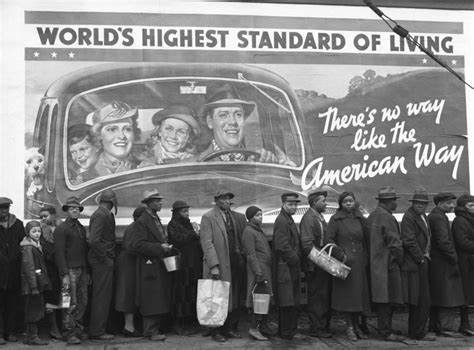
At the same time Margaret Bourke-White was in Kentucky not part of the FSA project. She saw a line of people, displaced by a flood, the people were queuing underneath a billboard she created “Kentucky Flood”, the billboard shows an all American white family with the slogan “Worlds Highest Standard of Living” then a second line stating “there’s no way like the American Way” (Bourke-White, 1937) a truly powerful image as it includes black people, waiting in line for relief from hunger. With a white family enjoy the American dream.

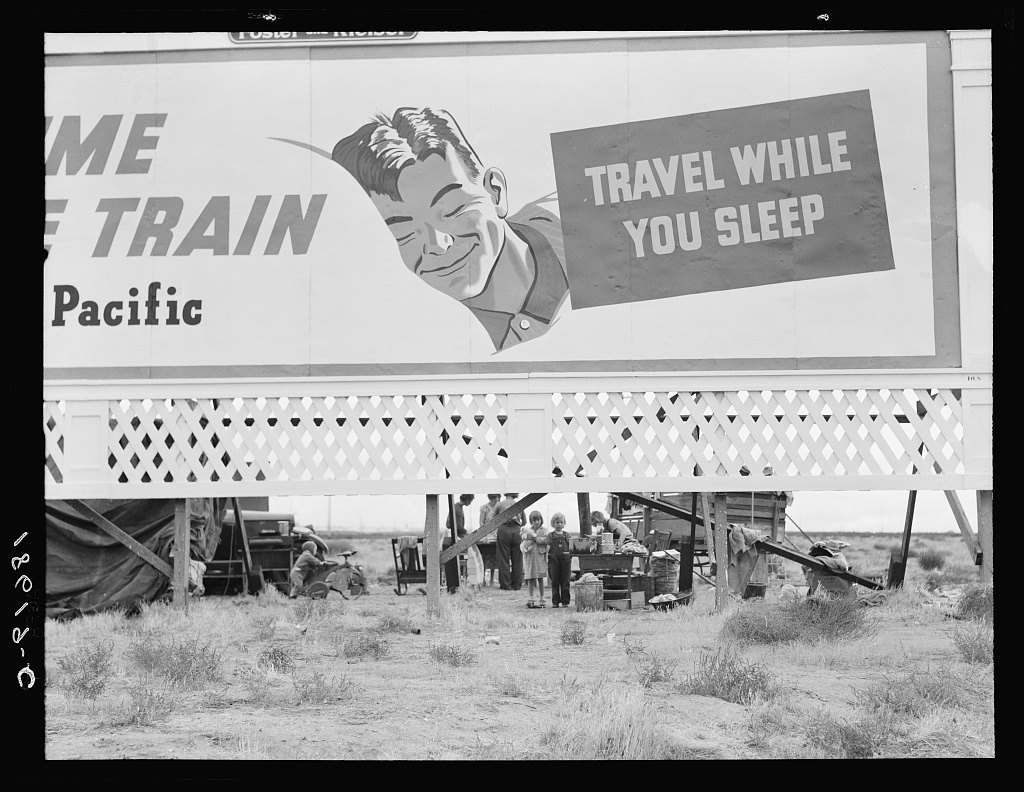
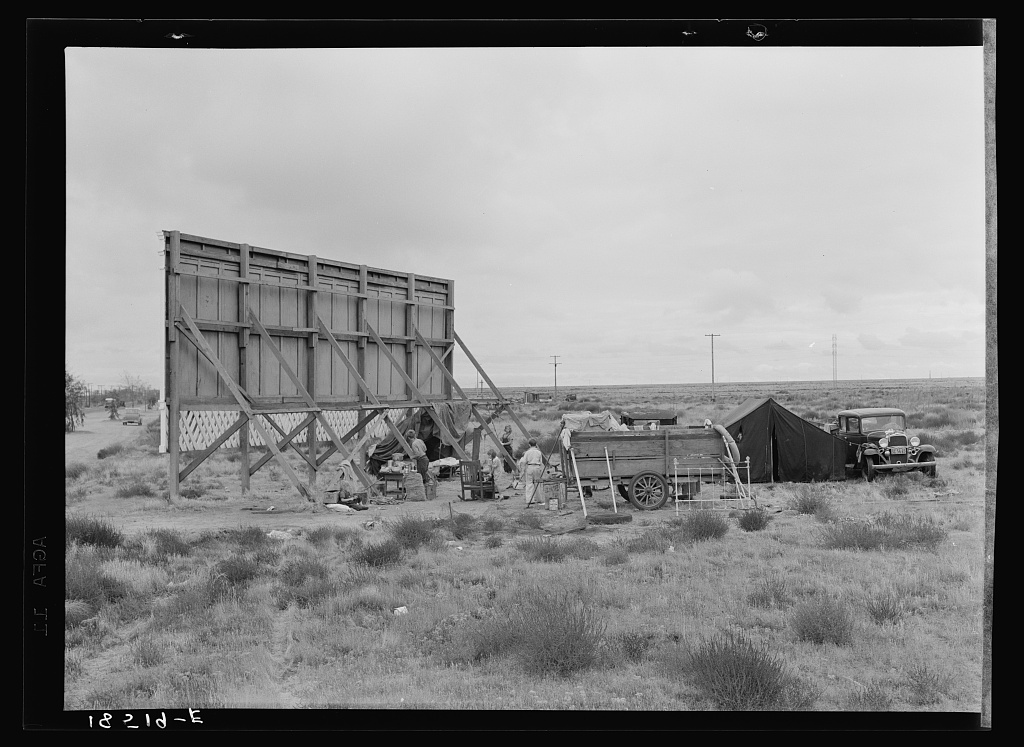
Concurrent to Bourke-White, Lange had been sent to document peoples living conditions along Route 99 in California. It is my interpretation that Lange must have been aware of these photographs as she worked with and was friends with Evans and Locke. Life magazine published “Kentucky Flood”. Around this time she took several shots showing billboards in the landscape but then she made several shots of Pea Pickers using bill boards as shelter. She made “Dispossessed” (Lange, 1937). This photo is less tidy and to me looks like it is a true record of the scene not staged at all.

A little later in the day she made “Towards Los Angeles”. The Billboards in all these exposure are for Southern Pacific Railway but all have different pictures and slogans. None would have been suitable for the two walkers shown in “Towards Los Angeles” as they all had too much of the clutter around the billboard.

Researching this photo took me to the Farm Security Administration. This organisation was formed as part of President Franklin Dwight Roosevelt’s, New Deal. The organisation was tasked with recording the plight of the agricultural population of the United States. Roy Stryker was employed to head the documentary department.

Roy Stryker was an academic specialising in economics. He applied his academic knowledge to his given task. He said “Our editors, I’m afraid, have come to believe that the photograph is an end in itself. They’ve forgotten that the photograph is only the subsidiary, the little brother, of the word” (Stryker, 1936).  He realised that photographers with an artistic background would help him gather the images needed to support the written word. He was a firm believer that photographs supported written words and was only part of the truth to be shown.

Stryker had served in the infantry during World War One. This would have given him self discipline and could have been a part of creating his over bearing reputation. In 1964 Lange described his working practices thus “That freedom that there was where you found your own way, without criticism from anyone, was special. That was germane to that project.  That’s the thing that is almost impossible to duplicate or find. Roy Stryker…had an instinct for what’s important. Its instinct. And he is a colossal watchdog for his people. If you were on the staff, you were one of his people, and he was a watchdog, and a good one” (Lange, 1964).

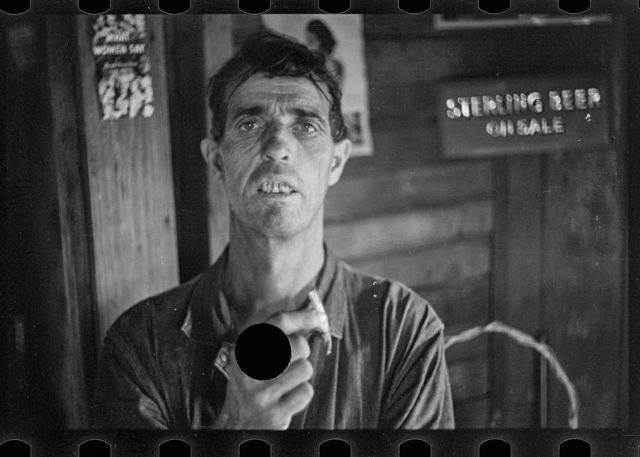
Much of the work I researched spoke about Stryker being a micro manager, who told his team of photographers what to read, where to go, the things to shoot and how to show them. I then found some examples of Stryker and his assistants taking a hole punch to exposures that they felt didn’t meet the brief. I found this shocking. In completing my research I found letters from Stryker (Library of Congress, Various dates) in which he talks about the cost of setting up shoots and questions such small amounts as $5 for travel. He was in control of every detail of his brief, supervising all parts of the work his team produced.

In an interview in 1997 Naomi Rosenblum the author of A History of women photographers (Rosenblum 1994) describes the FSA process “In common with other government agencies that embraced photographic projects, the FSA supplied prints for reproduction in the daily and periodical press. In that project photographers were given shooting scripts from which to work, did not own the negatives, and had no control over how the pictures might be cropped, arranged and captioned. There position was similar to that of photojournalists working for the commercial press – a situation that Evans and Lange found particularly distasteful” (Rosenblum, 1997 336-9).

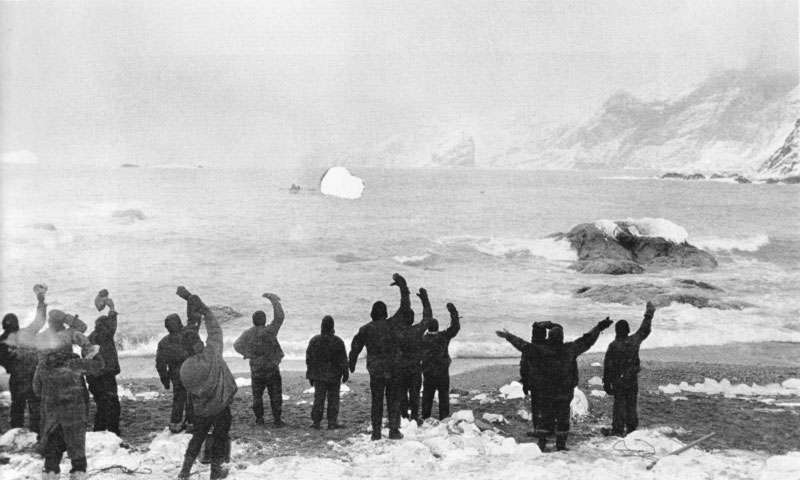
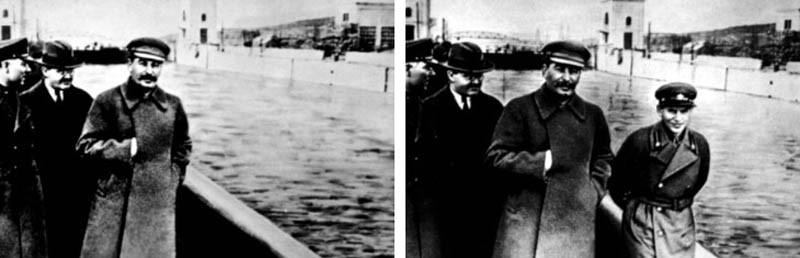
Stryker frowned on manipulation of images evidenced by his reaction when Dorothea Lange removed a floating thumb from “Migrant Mother” (Lange, 1937) Stryker admonished her for doing so. However at this time many famous photographs were manipulated Josef Stalin had Nikolai Yezhov removed from a photograph taken at Moscow Canal (Getty Images, 1934) and Frank Hurley photographer on the Shackleton expedition removed a second boat from the famous “Rescue by the Yelco” (Hurley, 1916) a photograph taken of the crews rescue. He simply scratched the second boat from the negative to add drama. So manipulation was employed long before photoshop (Adobe, 1991).

The FSA produced 164,000 monochrome negatives. 77,000 were made into prints (Library of Congress, 2012). 664 colour prints were produced from 1600c negatives. They featured in the press and in magazines making the cover of Time and Life magazine to show the suffering to all people in the USA. They created a picture of the Great Depression and triggered social changes in both housing and working conditions across the states.

Roy Stryker receives a criticism, I see a man who was educated, focused and understood his brief totally. He also understood he needed to direct his team who were working remotely with little supervision. We live and work in an environment utilizing the internet to give us almost instant reaction to our work. Think of sports photographers they send photos from the stadia direct to their office, getting the image into print or online in seconds. Stryker’s team had to post film into their office taking days to reach Washington. Then the images were processed and a contact sheet would be returned to the practitioner to be captioned and returned. This process would take at least fourteen days. Stryker would need to micromanage this to control it.

Whilst completing my research I found several letters to and from Stryker one of which admonishes the photographer for duplicating the same image five times (Library of Congress, 2012). These negatives would need to be destroyed to save filing space. He also made decisions about exposures whether they were in focus and whether complied with the Governments brief. With 77,000 images to control the process would need to be efficient so the work process could be efficient. I think of my digital library and the issues I experience keeping it clearly catalogued.

All of this begs the question did he trust his team of highly experienced photographers to deliver the photographs he needed to deliver his brief?

I think Stryker trusted his team based on letters (Library of Congress, 2012) he had a tight rein on the shots he wanted from photographer’s who had just started working with the FSA and he gives a free rein to the local organisation to create an itinerary of shots with Dorothea Lange. If she had been given a strict set of instructions I feel Lange wouldn’t have produced “Towards Los Angeles”.

Early in the project Stryker would destroy unwanted exposures with a hole punch. Ben Shahn another FSA photographer said “Roy was a little bit dictatorial in his editing and he ruined quite a number of my pictures, which he stopped doing later. He used to punch a hole through a negative. Some of them were incredibly valuable” (Arbuckle, 2009). Evans and Lange were vociferous from the start about this issue. He listened to the concerns of the photographers stopping this later in the programme. Most of the photographers had protested against the destruction of their images.

In 1942 during WW2 the FSA was incorporated into the Office of War Information. Stryker employed Paul Vanderbilt to catalogue, improve and simplify access to these images. They arranged for the images to enter the Library of Congress, Vanderbilt went with them and continued his cataloguing work. Many would have just walked away job done, Stryker worked to ensure the collection not only was secured but was kept for all to see.

So far I have considered the way the FSA and Stryker organised the brief to gather the shots needed to support this national story. Discussing his dictatorial style, his prescriptive demands could have predisposed the photographers such as Lange to stage their images. If she did would it matter? I don’t think so. Lange had been tasked with showing the gap between the haves and have not’s. This photograph achieves that.

Arthur Rothstein staged some of his scenes for the FSA. Photographs that captured the workers suffering supported the word. Stryker was overbearing, however he recognized his team’s strengths and allowed them some freedom after he had guided them, if they strayed he would not allow the work to progress. He kept tight rein on the purse strings and wanted control of everything from beginning to end. His military background coupled with his academic disciplines gave him the skills to do this. He was the catalyst behind this great project. Without him it would have been quite different, then at the end of the project he ensured its preservation for future generations to view.

This journey has taken me to many stops before I arrived at my destination. Critiquing “Towards Los Angeles” has allowed me to discover the workings of the FSA under Stryker. Without Roy Stryker this collection would probably not exist. We certainly would not have such a concise collection to view and revere.

To read my research and see the letters described please follow the link below. https://michaelgreenlevel2landscapeblog.photo.blog/2020/04/09/research-for-assignment-4-review-of-towards-los-angeles-by-dorothea-lange/

Word Count without references 2004. Word Count with References 2061.

Works Cited

Adobe. (2020). Photoshop. Adobe Photoshop . San Jose, California, USA: Adobe.

Angelo, M. Creation. Sistine Chapel, Rome.

Arbuckle, A. Q. (2018, June 23). ‘Killed’ photographs. Retrieved April 16, 2020, from Mashable: https://mashable.com/2016/03/26/great-depression-killed-photos/?europe=true

Bourke-White, M. The Louisville Flood. Art and Artists. Whitney Museum of American Art, New York.

Bresson, H. C. Behind Gare Saint Lazarre. MoMa, San Francisco.

Delano, J. a. (1965, June Puerto Rico). Oral history interview with Jack and Irene Delano, 1965 June 12. (R. Doud, Interviewer)

Evans, W. Houses and Billboards in Atlanta. Art and Artists. Museum of Modern Art, New York.

Hurley, F. Rescue by the tug Yelco. South. London.

Lange, D. Disposessed. Office of War Collection. Library of Congress, Washington.

Lange, D. Migrant Mother. Destitute pea pickers in California. Mother of seven children. Age thirty-two. Nipomo, California. Library of Congress, Washington.

Lange, D. Towards Los Angeles. FSA Photographs. Library of Congress, Washington.

Library of Congress. (n.d.). Library of Congress. Retrieved April 19, 2020, from Library of Congress: http://www.loc.gov/pictures/collection/fsa/

Locke, E. Road sign near Kingwood, West Virginia. FSA Photographs. Library of Congress, Washington.

Quotes, A.-Z. (2020, April 21). Retrieved April 21, 2020, from A_Z Quotes: https://www.azquotes.com/quote/1444575

Rosenblum, N. (1994). A History of Women in Photography. New York: Abbeville Press.

Rosenblum, N. (2010). A history of women photographers. In N. Rosenblum, A history of women photographers (pp. 336-339). New York, London and Paris: Abbeville Press.

Southern Pacific Railroad. (1937, March). San Francisco, California, USA.

Striker, R. (1936, April 6). Library of Congress. Retrieved May 1, 2020, from Library of Congress: https://www.loc.gov/resource/ppmsca.54306/

Stryker, R. (1936, April 6). Library of Congress. Retrieved April 19, 2020, from https://www.loc.gov: https://www.loc.gov/search/?in=&q=roy+stryker&new=true

Unknown. Josef Stalin Group at Moscow Canal. Josef Stalin Great Purge Photo Retouching. Fine art images/Heritage Images/Getty Images and AFP Group, Chicago.

Walther, P. (2008). New Deal Photography. Koln: Taschen.

Walther, P. (2008). New Deal Photography. In P. Walther, New Deal Photography (pp. 18-19). Koln: Taschen. Wells, L. (2015). Photography a critical introduction. London and New York: Routledge, Taylor and Francis Group.
Assignment 4 Critcal Review of “Toward Los Angeles” by Dorothea Lange. Rework.

Toward Los Angeles Lange 1937.

In this review of Dorothea Lange’s “Towards Los Angeles” (Lange 1936) I want to consider the photograph and look at its structure, context and its meaning. Why did she take it? What does it say? Finishing with how the photograph sits within the Farm Security Administrations work.

The photograph was taken in February 1936 during the Great Depression in the United States. It is a Silver Gelatin Print taken during her work around El Monte and San Fernando, California for the Farm Service Agency (FSA). It is taken on the road to Los Angeles.

The work is a landscape with a billboard and two men walking along a road lined with telegraph poles. The both carry luggage. The man on the left is carrying a suitcase in his left hand whilst the man on the right is carrying a canvass holdall on his right shoulder. They both look like Cowboys or at least farm hands. The luggage they carry looks to be in good condition and the clothes they are wearing appear to be in good order. The left mans right shoulder is drooping due to the weight of his luggage.

Both men`s necks and hands are visible and look well tanned from hard days working on the land that this road snakes across. Their feet are in different stages of walking the right mans left foot is off the ground and the man on the left has is right foot raised off the ground in a purposeful march into the future.

The road they are walking on is a tarmac road with a dusty verge and they are walking with the billboard to their right. The bill board says “Next time try the train”, with a line underneath that states “RELAX” accompanied by the name of the railroad placing the advert “Southern Pacific”. Underneath the billboard there is a trellis to finish off the billboard but it adds a new texture to the picture.

From the left edge of the picture run telegraph poles at least ten in number run along the verge of the road. On the right side a series of fence posts runs between the men and the billboard forming a barrier between the longed for better life and the walk. The surface of the dusty verge is indented with the treads of the cars which have pulled over off the tarmac for unknown purposes.

The billboard appears to be on land between the fence and open farmland the type of land these men are leaving. There is a second less prominent fence behind the billboard which emphasises the lead line it forms.

The sky makes me think it is blue and peppered with wispy clouds being blown into majestic lines which luckily add to the lead lines in the rest of the picture. It is a bright sunny day with little wind on a dry dusty day.

The line of telegraph poles and the fences form a great lead line into the picture and give it feel of great perspective emphasising the distance these men have yet to travel. The billboard makes a statement just in its presence. The lines of perspective are added to by the tire tracks and even the clouds being blown into shape in the air. The right hand verge adds a shadow which breaks up the photo and adds the strongest lead line in the photograph.

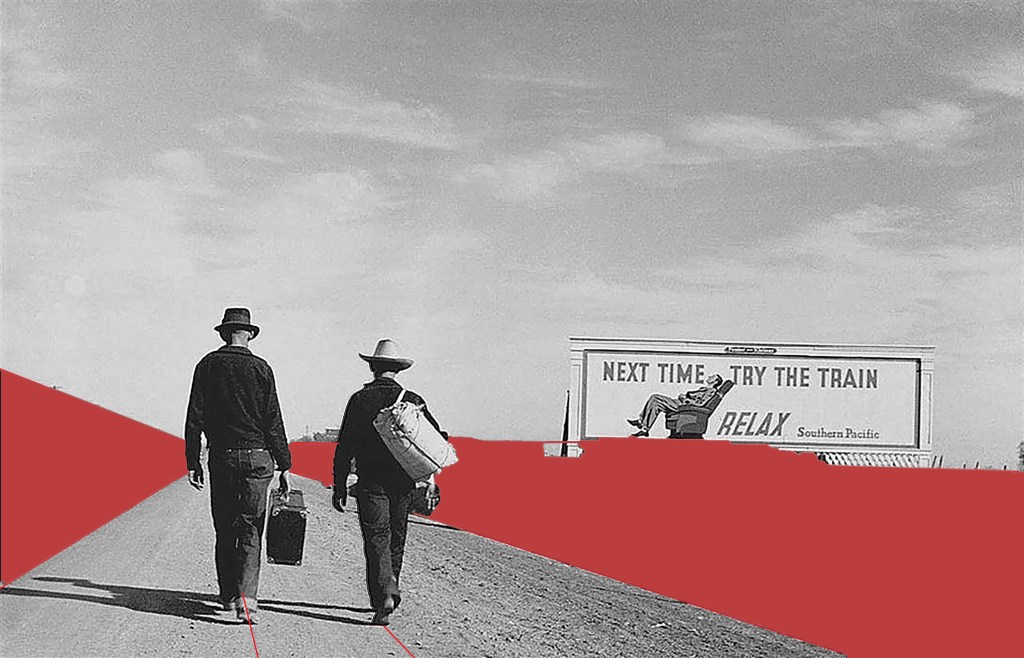
The photo whilst having these strong lead lines also follows the rules of thirds if you draw a line through the left shoulder of the left man from top to bottom you get the space for the telegraph poles, Do the same through the right shoulder of the man on the right you get a space for the men with a third segment for the billboard.

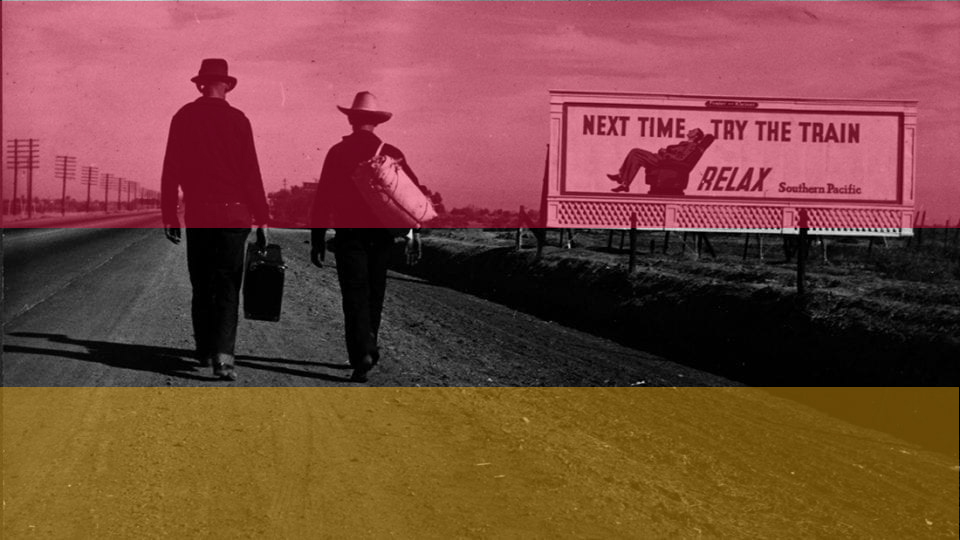
It also follows this rule horizontally the line of the horizon gives a large empty space, secondly a line across the picture level with the soles of the feet has all the detail in it. Finally the lower space has the tarmac road and the dusty verge forming a second empty space.

The last observation I make looking at the photograph is that the men are taking no notice of the billboard they seem to be just focused on the task in hand the journey through this landscape to a hoped for better future.

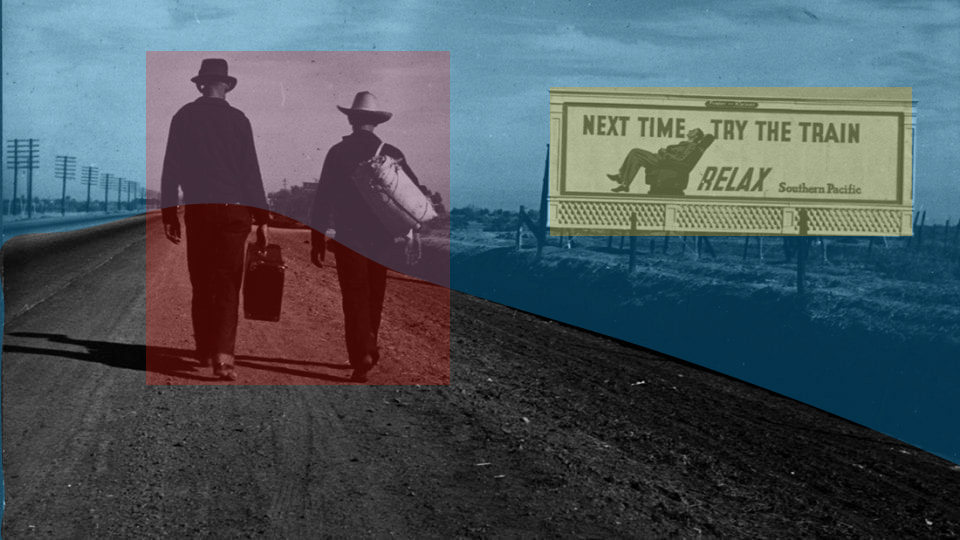
Within the frame I see a triangle formed with the perspective of the road between the verge and the telegraph poles. Then two rectangles one is the obvious one in the billboard, the second one is formed by the sky. Finally is see a square around the two men walking?

At first glance the picture appears balanced and almost flat. However look further and you see the perspective formed by all the lines. Then the Billboard throws the picture out of balance and you see the writing this begins the questions and made me laugh when I read the words. Then men then throw the picture back into balance with all the action in the middle section.

The contrast is uniform in most of the picture, one element the dark verge to the right emphasises this lead line and takes you into the picture to the billboard.

Feet walking into the scene give a sense of movement and hint at the long journey being completed. The lead lines emphasise this journey adding a sense that this walk is to be a long one which alternatively could be made by rail. The lines guide you into the photo and to the billboard. The sky and the land show that this is big country. Telegraph poles disappearing are the last element giving a sense of distance yet to travel.

My eye goes to the centre of the photo to begin with but this area is empty between the men and the board. Sometimes my eye goes left to the men and sometimes to the right to the billboard. My eye does this as the two main subjects are balanced on the central line. Then my eye looks at the telegraph poles and gets the sense of distance. The two men are darker than the rest of the photo so stand out due to their darkness. Then the board stands out because it is brighter than the men.

This photo is unusual as Lange usually takes photographs showing serious scenes. This has satire and subtle humour whilst still having a serious message. Shadows leading from the men’s feet hint that it is late in the day and they have already travelled far whilst having far to go. Reclining on a seat a man has an easy time travelling this same route whilst our two heroes have to suffer a long walk.

This work was created to document the suffering of the workers in the USA caused by the Great Depression. The failure of the crops coupled with banks foreclosing on loans led to mass migration of people across the USA. This is summed up in one simple shot. In a fraction of a second Lange has caught the migration of agricultural workers who can’t even afford a rail ticket. She has then presented it with humour showing how these people just got up and got on with it. What choice did they have?

When I was completing my research I watched a film in which Dorothea Lange and John Swarkowski use on of Lange’s favourite sayings “Grab a hunk of lightning” she certainly did that here.

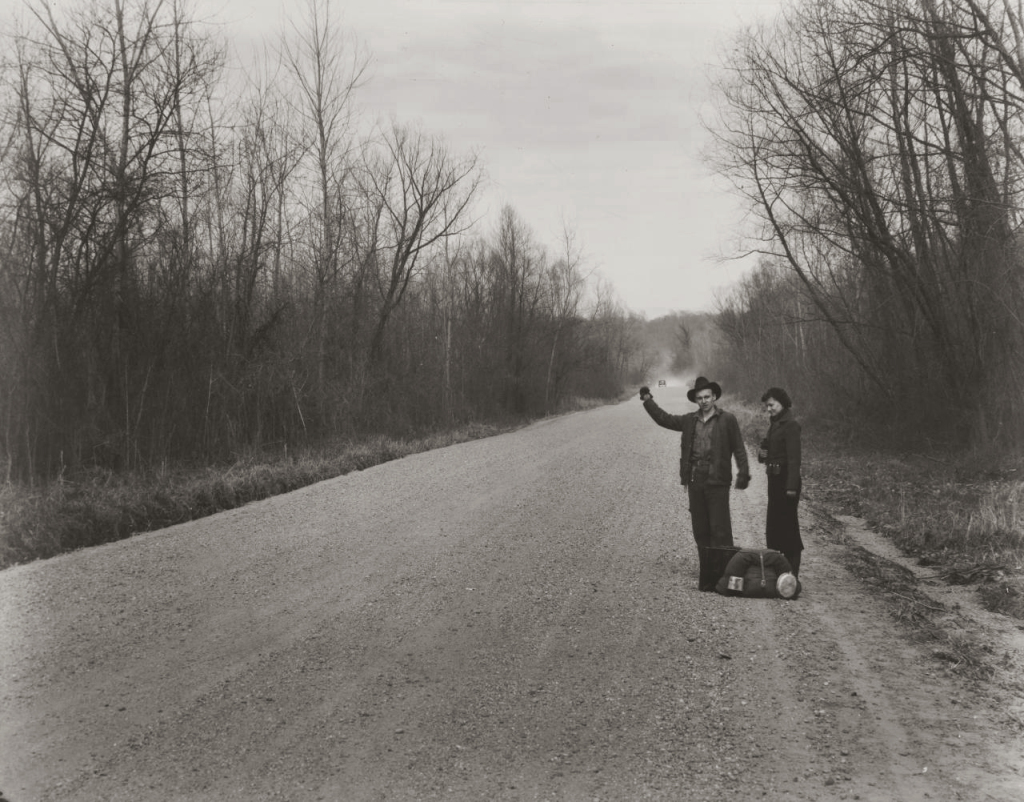
I find this work rewarding to look at, “Always look on the bright side of life” (Idle 1980) comes to mind when I see this photograph. These men are walking to a hoped for brighter future. I see the same thing in Walker Evans photograph “Hitch hikers near Vicksburg Mississippi” (Evans 1935), however Lange has added the billboard in her shot, this added element makes it more palatable but takes nothing away from the serious message.

 This photograph has travelled well through the 80 years since it was taken. We have migrants across the world moving to find better futures for their families caused by financial institution and governmental mistakes. Different times same mistakes.

Looking at this exposure gives me a sense of hope for the future whilst dreading the past left behind. I wonder if these two men have left families behind who will join them once new hopeful lives have been created. Much like when I see the male refugees arriving on the shores of Europe today.

This work is poignant, funny, striking, timeless and disturbing all at the same time. It is a beautiful, simple depiction of an ugly subject. Much like some of the work we see in the media capturing the hope people have when they suffer indignities to get to a Promised Land.

This work is a huge success it makes me think. I want to know the stories behind the footsteps and I want to find out where the steps into the unknown led these two men. I want to understand what led to this Hunk of Lightning. If I had seen the photo at the time it was taken I would have spent time to find out all I could and would be doing all I could to help. Whether it is beautiful or ugly is unimportant it is a success because it makes me care.
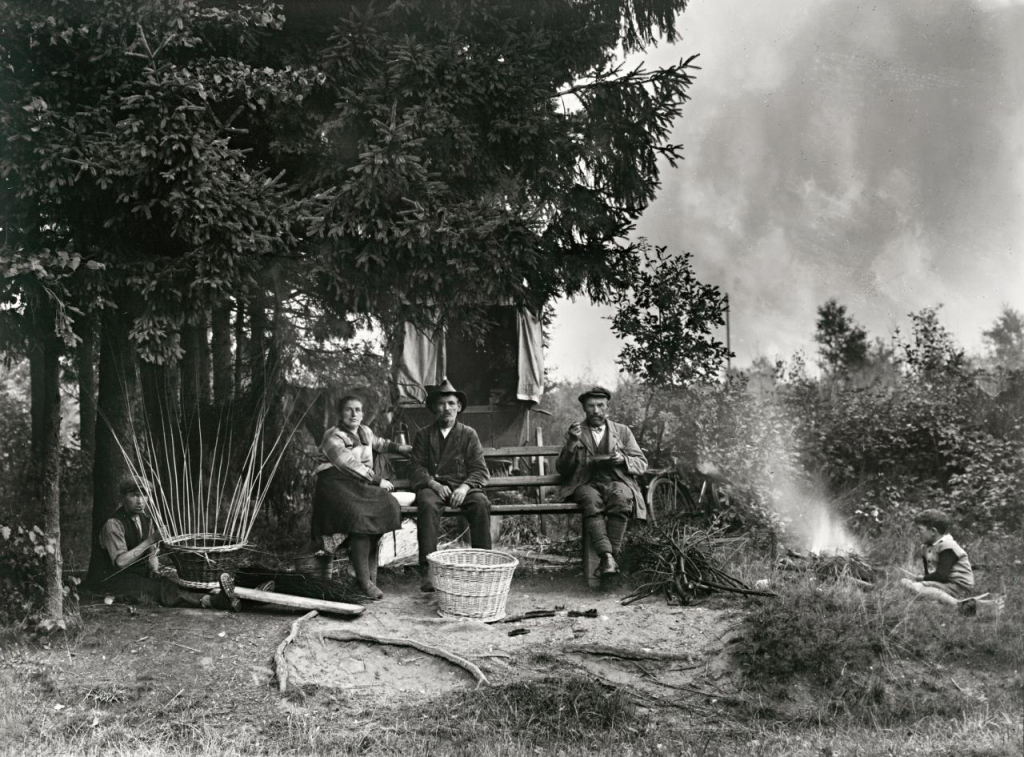
On first seeing this photograph I thought it was original, doing my research though led me to several examples where a similar scene was shown. August Sander shows a similar scene with “Itinerant Basket Weavers (Sander, 1929) as does Walker Evans in “Hitchhikers near Vicksburg Mississippi” (Evans, 1939). The difference is the billboard this adds a memorable element, at first funny then thought provoking. Interesting that Lange and Evans knew each other and took similar shots of the same subject in the same year did they compare and discuss their work?

Dorothea Lange used her camera well by understanding her brief from the FSA and applying it to what was on the road to tell the story, however she used her number one and number two instruments exquisitely, her eye and her brain. She will have had moments to see and set up this shot, she did it superbly.

In looking at this exposure I began by critiquing it as a photograph but have ended relishing it for the mood it creates. It captures the situation these people were forced into then shows the spirit of these two humans in dealing with their situation. Lange then shows us some humour and we empathise with these two men. We all enjoy a little humour even dark humour in times of trouble.

These individuals are going on a journey together, I am going with them. More than this I want to get involved not just with these individuals but with the struggle the farmers are suffering. Some critics of photography have pointed out that “privileged people” use their cameras to look down on poor subjects. I believe this work and others like it encourage us to find out more, when other organisations may not want us to see it at all.

Writing this review made me think of a lyric in the song “Walking down Madison” (McColl, Marr, 1982) that says “From the sharks in the penthouse to rats in the basement, it’s not that far”, making me think how precarious all our lives are. It doesn’t take much to put me on a journey to a new place to find a new future…….scary.

All this from one photograph that at the outset looked like a simple, slightly humorous shot. If you set out with an interest and have an open mind it is amazing where these practitioners can take us.

“Compassion is an unstable emotion. It needs to be translated into action, or it withers. The question of what to do with the feelings that have been aroused, the knowledge that has been communicated. If one feels that there is nothing ‘we’ can do — but who is that ‘we’? — and nothing ‘they’ can do either — and who are ‘they’ — then one starts to get bored, cynical, apathetic.” (Sontag, 1964).

We must not be apathetic.

Works Cited

Evans, Walker. Hitch hikers near Vicksburg Mississippi. FSA, San Francisco.

Grab a hunk of lightning. Directed by Dyanna Taylor. Performed by Dorothea Lange. 2014.

Lange, Dorothea. Towards Los Angeles. MoMA, Chicago.

Maccoll, Kirsty. Walking down Madison. Comp. Kirsty Maccoll and Jonny Marr. 1982.

Python, Monty. Always look on the brightside of life. Comp. Eric Idle. 1979.

Sander, August. Itinerant Basket Weavers. National Gallery of Victoria, Victoria.

Sontag, Susan. “On Photography.” In On Photography, by Susan Sontag. New York: Penguin, 1978.

Tutor feedback for Assignment 4 Towards Los Angeles by Dorothea Lange.

Below is the feedback I recieved from my tutor in regard to my critical review for Assignment 4. Since my feedback I have signed up and completed work with the Royal Literary Fund. This has started my journey towards mastering the skill of writing in an academic way.

I have begun to read Umberto Eco “How to write a thesis” and have read “Cite them rite”.

I have also completed an online course in Japanese Stab Binding and have ordered the materials and the tools to make a photobook with the control over the whole process.

Research for Assignment 4 Review of “Towards Los Angeles” by Dorothea Lange.

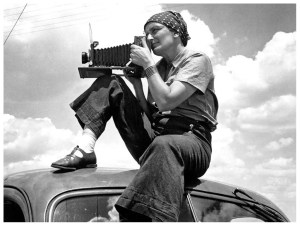
Dorothea Lange at work 1936. (Lange, 1936).

In this research I will look at Towards Los Angeles a photograph by Dorothea Lange taken in the great depression in the USA. Before I critique this photograph I would like to discuss the journey the artist took to get to the point of taking this photo.

Dorothea Lane was born on the 26th of May 1895 in Hoboken New York her birth name was Dorothea Margareta Nutzhorn her parents were of German dissent and were named Heinrich Nutzhorn and her mother Johanna Lange. In 1907 her father abandoned the family who were completed by a boy, Martin. When this happened Dorothea dropped her middle name and took her mother’s surname becoming Dorothea Lange.

At age seven she contracted polio and while many would see this as a handicap Dorothea embraced it saying “It formed me, guided me, instructed me, helped me and humiliated me. (Lange, 1998)” After graduating from school she attended Columbia University where she was tutored by Clarence H. White. Leaving university she worked in several of the best photographic studios in New York.

Her wanderlust took her on a trip with her friend they planned to see the world but were robbed in San Francisco so they settled there. She worked in photo studios meeting several influential people who helped her set up a successful studio taking photos of the wealthy. In 1920 she married Maynard Dixon and over the next ten years had two sons.

During this period she completed several projects one being of the unemployed and homeless. She by chance took an exposure at the soup kitchen run by a widow nicknamed “The White Widow” (Lange, 1936). This photo naturally had the title “White Angel Breadline” (Lange, 1936). It was liked locally by influential practitioners’ and it led to work with the Resettlement Administration (RA) the forerunner of the Farm Security Administration (FSA).

FSA Logo (1936)

During 1935 she divorced Dixon and married the economist Paul Schuster Taylor. Taylor was a Professor of Economics at the University of Berkeley. They went onto record the poverty around the area where they lived. Taylor wrote pieces about the families encountered while Dorothea photographed them.

Towards Los Angeles Dorothea Lange 1937

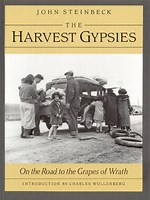
Working for the FSA allowed her to capture some of the most important photos of the time. “Migrant Mother” (Lange, 1937) is one of the most revered images of all time and was taken around the same time as “Towards Los Angeles.” (Lange, 1937) Many of her photos were printed by the “San Francisco News”, when they supported John Steinbeck’s work “The Harvest Gypsies” (Steinbeck, 1936), a collection of articles about the farmers suffering the depression supported by images including “Migrant Mother”.

John Steinbeck Pamphlet Harvest Gypsies 1938.

Her next big piece of work was documenting the lives of interred Japanese-Americans; this work was carried out for the War Relocation Authority. She applied herself to the plight of these people so well that the government wouldn’t let them be seen. They didn’t want any sympathy for the Japanese citizens.

In 1945 Ansell Adams asked Dorothea to teach at California School of Fine Arts. Their friend Imogen Cunninham from Group f.64 joined at the same time.

Life Magazine Logo

She Co-founded the magazine LIFE in 1952 and Dorothea did several pieces of work for this magazine including the damming of Berryessa and its effect on the residents. Again she documented the suffering warts and all.

Then in 1952 Dorothea Co-founded Aperture Magazine which is still in print today she had been familiar with Group f.64 and the magazine this group produced called “Camera Craft” (Lange, 1935).

Apperture Magazine Logo

John Szarkowski displayed her work at the MoMA between 26th January and 10th April 1966. He couldn’t believe the collection of work she held at home and how well they were indexed. She worked tirelessly even though her health was now failing.

From about this time until her death in San Francisco her health suffered. She died from Cancer on October 11th 1965. She must be remembered for her favourite saying “Grab a Hunk of Lightning”.

Susan Sontag (Sontag, 1979) says about privileged photographers hanging around the oppressed and even looking down on people. “Social misery has inspired the comfortably off with the urge to take photographs”. Susan Sontag On Photography ISBN 978-0-141-037678-9 Page 55 Par 1 Line 8. I don’t feel this with Lange. I see someone who wanted to tell the story visually whilst improving the lives of the people photographed and the ones who were not.

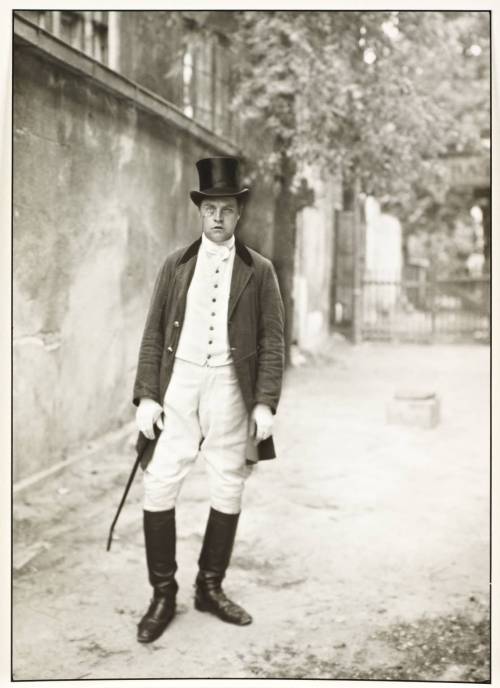
August Sander`s work recording the vocations of Germany work inspired Dorothea Lange and others working for the FSA.  In researching the work of the FSA I came across an on line essay written by Marcello De Aroujo, Professor at the University of Rio de Janiero Brazil (Aroujo, 2016). https://theconversation.com/world-war-i-to-the-age-of-the-cyborg-the-surprising-history-of-prosthetic-limbs-64451

The Jockey August Sander 1926

In it he discusses the returning German casualties being fitted with Prosthetic limbs. The Red Cross produced a book entitled “Reconstructing a man” in 1918. It acknowledges the fact that thousands of men were returning home and being “repaired” in fact made better than their pre-war selves by being fitted with prosthetic limbs. They even termed them “Homo Prostheticus”. These “Robots” could complete their work more efficiently than they could have before the war. Could this have been a driver for Sander to record the normal people who did these tasks less efficiently as well as recording the disappearing people pre metropolis? Was he afraid they would be taken over by man machines, and then later he may have seen the war coming with more “Homo Prostheticus” men to flood the county?

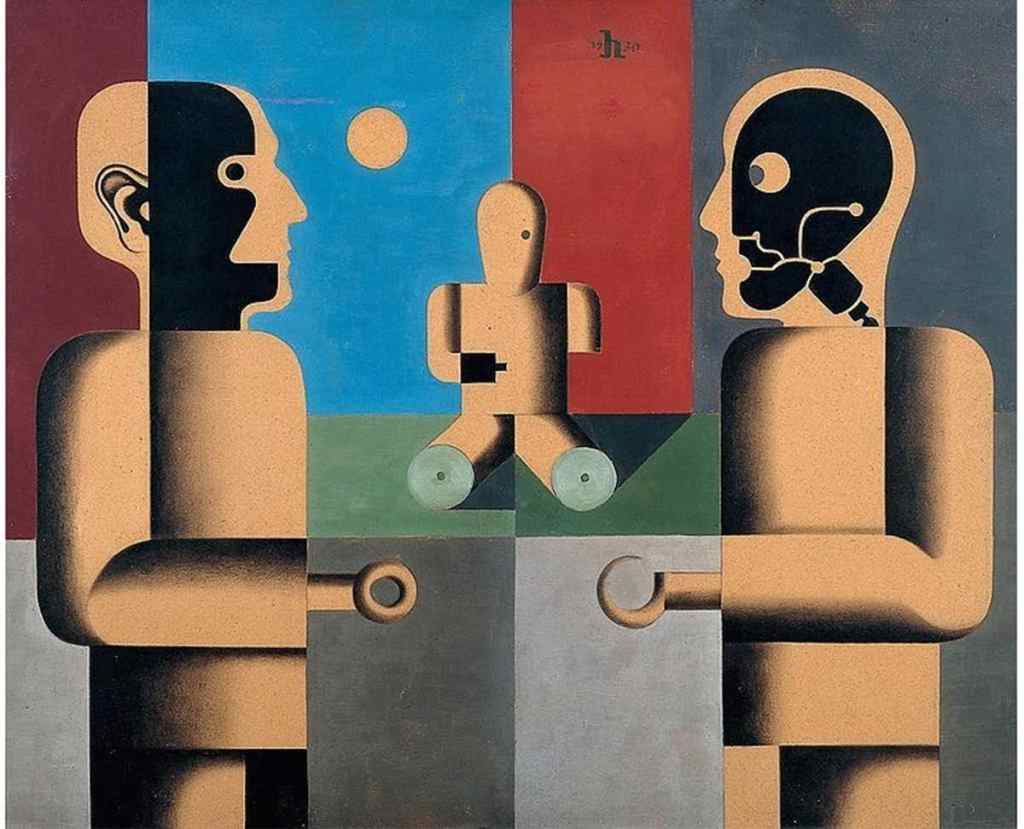
Heinrich Hoerle painted “Monument of the Unknown Prostheses’ (Denkmal der unbekannten Prothesen, 1930)”. To show how man had returned and being fitted with prosthetic limbs and had become an uber efficient machine a “better” version of himself. Hoerle wanted to questions this pointing to the anguish these individuals suffered due to their injuries. They were not “Uber Menschen” but victims of war injuries.

Heinrich Hoerle “Monument of the Unknown Prostheses’ (Denkmal der unbekannten Prothesen, 1930)”.

The photographers working for the FSA were doing much the same work. Sent out into the landscape to document the suffering of those people living on the land. These people were injured by the Great Depression and their injuries were mental, but just as damaging as losing a limb. You can see the mental anguish in the photograph “Migrant Mother” (Lange, 1936). Dorothea Lange captures it perfectly you can see the vulnerability of this woman at the same time seeing her pride, fear and concern for her offspring all in equal measure.

Migrant Mother (Lange, 1937).

In the “Great Depression” Franklin D Roosevelt set up several administrations to help show the state of the nation. Then to suggest and document any improvements carried out to improve the situation in the nation. One of these administrations was the Farm Security Administration (FSA).

The man placed in charge of the FSA was Roy Stryker. He was an academic and a man who had served in the US Infantry in World War One. He was disciplined and intelligent so had the right characteristics to complete this huge task. He thought photography was excellent at supporting the written word so employed 13 proven photographers (Dorothea Lange, Arthur Rothstein, Walker Evans, Ben Shahn, John Vachon, Marion Post-Walcott, Russell Lee, Jack Delano, Gordon Parks, John Collier, Carl Mydans, Edwin Rosskam and Louise Rosskam) to capture images across the USA. At the end of the FSA work in 1942 when the FSA was incorporated into the Office of War Information Stryker used all of his discipline to catalogue and archive these exposures including many of the ones with holes punched in them. He was assisted by

This project was a huge undertaking and he would have needed all of his military experience of logistical organization coupled with his knowledge of the US to send these few out into the field to capture the images. He was dictatorial in his approach, giving exposure lists to each of the photographers. Some as detailed as “A white house, with a white fence”, He wouldn’t let the photographers stray from his scripts.

When the negatives came in to his office in Washington he would review each one and any Stryker didn’t like or were out of focus or off topic would be destroyed with a hole punch. Most of the photographers were dismayed to see their work treat in this manner and complained to Stryker. Later in the project he relaxed this practice.

Photo showing a hole punched in it (LoC, 1937).

I found it interesting to consider the time scale for each part of the project exposures were made then posted into Washington, Stryker reviewed and printed them and sent them back to be captioned then they were returned to the office for use. This could take two or three weeks. Lange kept detailed notes of what was said by her subjects so she could caption the photos, often with the words the subjects had spoken. These are all kept and shown in the Library of Congress in Washington and are available to all online.

The FSA created 77,000 negatives including 644 in colour they are a record of the conditions agricultural workers were enduring trying to support themselves and their families. Most are regular shots fulfilling Stryker’s lists but some are moving and works of art. I do wonder as I look at Towards Los Angeles if it was staged and looked at examples from before this time where photographs had been manipulated to understand how far photographers and organizations would go to put across a theme.

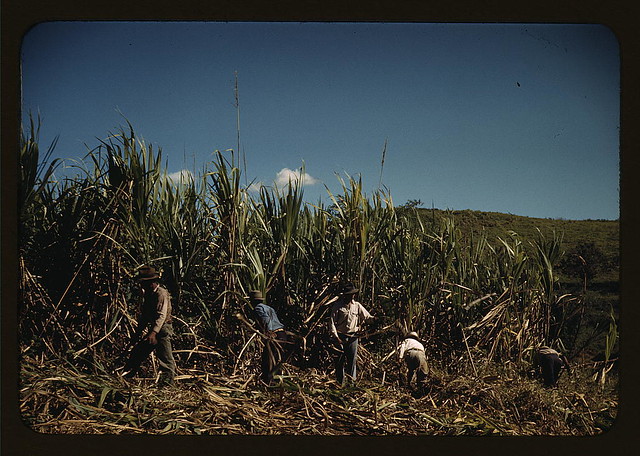
Farm Labourers in Sugar Cane Jack Delano 1941.

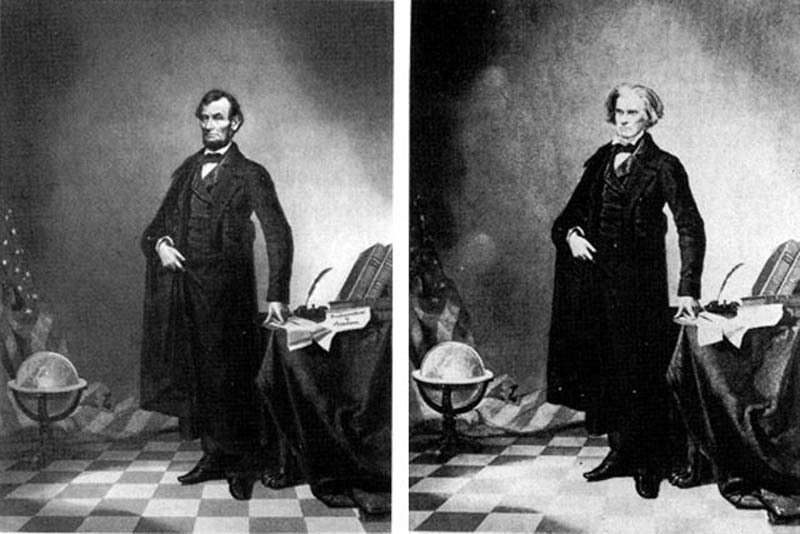
Joseph Stalin had people removed from photographs as they fell out of favour. One shows a young commissar stood in a group by a river he must have fallen from grace because in later versions he is missing. Frank Hurley who was the photographer on Shackleton`s ill fated expedition recorded all aspects of the journey, but in the rescue photo only one lifeboat rows to shore, he had scratched out the other to make the exposure more dramatic. He had manipulated earlier photos to create his postcard business in Australia. Even Abraham Lincoln had featured in a manipulated negative when his head was imposed on John Calhoun’s body to make a well-used image. So well before Lange took Towards Los Angeles images were being altered to project a message.

I can find no evidence for Lange having manipulated the exposure and do not think she would do so. However the photo does look as if some staging may have been employed. The fact it is so perfectly aligned to the rule of 3rds both in the horizontal and the vertical. The timing of the steps almost too perfect a decisive moment. The tracks in the dust on the road verge suggests someone pulling over and discussing the staging. Does it matter if it was staged?

I considered the billboard in Lange’s photo and wondered if others had used them before her. I found that Walker Evans had shown billboards in “Billboards and houses in Atlanta 1936 (Evans, 1936). Lange was a colleague and friend of Evans so would have been aware of this shot. Then I found “Kentucky Flood” (Bourke-White, 1937) a photo, which depicts a group of people queuing for relief in front of a billboard with an all-American family driving a car under the slogan “Worlds highest standard of living”. This was taken just weeks before Lange took “Towards Los Angeles”. She would also have been aware of this image as it was featured across the press and was the cover of “Life” magazine. Evans earlier shot showed just billboards whilst Bourke-Whites image combined people with the billboard making a powerful image.

This research should enable me to review Lange’s photo and possibly expand further work describing the FSA and all that it achieved.

Works Cited

Aroujo, Marcello De. “World War 1 to the age of the dyborg.” 6 23, 2016. https://theconversation.com/world-war-i-to-the-age-of-the-cyborg-the-surprising-history-of-prosthetic-limbs-64451 (accessed 5 21, 2019).

Bourke-White, Margaret. “The Kentucky Flood.” Whitney Museum of American Art. Art and Artists. New York.

Delano, Jack. “Farm Labourers in a sugar can field”. Library of Congress. Washington 1941.

Evans, Wlaker. “Houses and Billboards in Atlanta.” Museum of Modern Art. Art and Artists. New York, 1936.

Hoerle, Heinrich. Monument of the Unknown Prostheses. Berlin Museum of Art, Berlin.

Lange, Dorothea. Camera Craft. Camera Craft, 1935.

Grab a hunk of lightning. Directed by Dyanna Taylor. Performed by Dorothea Lange. 2014.

Lange, Dorothea. “Migrant Mother.” Library of Congress. Destitute pea pickers in California. Mother of seven children. Age thirty-two. Nipomo, California. Washington, 1936.

Lange, Dorothea. “The White Angell Bread Line.” MoMA. Chicago. 1936.

Lange, Dorothea. The White Widow. MoMA, Chicago.

“Library of Congress.” Washington USA: Library of Congress, 2020.

Library of Congress. “Library of Congress.” Library of Congress. http://www.loc.gov/pictures/collection/fsa/ (accessed April 19, 2020).

Sontag, Susan. “On Photography.” In On Photography, by Susan Sontag. New York: Penguin, 1978.

Stienbeck, John. The Harvest Gypsies. San Francisco: Pamphlet, 1936.

Assignment 4 Critical Review “Towards Los Angeles” by Dorothea Lange.

Towards Los Angeles Dorothea Lange 1936.

To complete this assignment I want to look at the photograph (1)“Towards Los Angeles” by Dorothea Lange. I chose this photograph as it is one of the lesser known works however to me it appeals showing pathos and humour in equal measure.

The photograph was taken in February 1936 during the Great Depression in the United States. It is a Silver Gelatin Print taken during her work around El Monte and San Fernando, California for the Farm Service Agency(FSA). It is taken on the road to Los Angeles.

The work is a landscape with a billboard and two men walking along a road lined with telegraph poles. The both carry luggage. The man on the left is carrying a suitcase in his left hand whilst the man on the right is carrying a canvass holdall on his right shoulder. They both look like Cowboys or at least farm hands. The luggage they carry looks to be in good condition and the clothes they are wearing appear to be in good order. The left mans right shoulder is drooping due to the weight of his luggage.

Both men`s necks and hands are visible and look well tanned from hard days working on the land that this road snakes across. Their feet are in different stages of walking the right mans left foot is off the ground and the man on the left has is right foot raised off the ground in a purposeful march into the future.

The road they are walking on is a tarmac road with a dusty verge and they are walking with the billboard to their right. The bill board says “Next time try the train”, with a line underneath that states “RELAX” accompanied by the name of the railroad placing the advert “Southern Pacific”. Underneath the billboard there is a trellis to finish off the billboard but it adds a new texture to the picture.

From the left edge of the picture run telegraph poles at least ten in number run along the verge of the road. On the right side a series of fence posts runs between the men and the billboard forming a barrier between the longed for better life and the walk. The surface of the dusty verge is indented with the treads of the cars which have pulled over off the tarmac for unknown purposes.

The billboard appears to be on land between the fence and open farmland the type of land these men are leaving. There is a second less prominent fence behind the billboard which emphasises the lead line it forms.

The sky makes me think it is blue and peppered with wispy clouds being blown into majestic lines which luckily add to the lead lines in the rest of the picture. It is a bright sunny day with little wind on a dry dusty day.

Leading lines.

The line of telegraph poles and the fences form a great lead line into the picture and give it feel of great perspective emphasising the distance these men have yet to travel. The billboard makes a statement just in its presence. The lines of perspective are added to by the tire tracks and even the clouds being blown into shape in the air. The right hand verge adds a shadow which breaks up the photo and adds the strongest lead line in the photograph.

Rule of thirds vertically.

The photo whilst having these strong lead lines also follows the rules of thirds if you draw a line through the left shoulder of the left man from top to bottom you get the space for the telegraph poles, Do the same through the right shoulder of the man on the right you get a space for the men with a third segment for the billboard.

Rule of thirds horizontally.

It also follows this rule horizontally the line of the horizon gives a large empty space, secondly a line across the picture level with the soles of the feet has all the detail in it. Finally the lower space has the tarmac road, dusty verge forming a second empty space.

The last observation I make looking at the photograph is that the men are taking no notice of the billboard they seem to be just focused on the task in hand the journey through this landscape to a hoped for better future.

Colour boxes and lines my eye sees.

Within the frame I see a triangle formed with the perspective of the road between the verge and the telegraph poles. Then two rectangles one is the obvious one in the billboard, the second one is formed by the sky. Finally I see a square around the two men walking?

At first glance the picture appears balanced and almost flat. However look further and you see the perspective formed by all the lines. Then the Billboard throws the picture out of balance and you see the writing this begins the questions and made me laugh when I read the words. The men throw the picture back into balance with all the action in the middle section.

The contrast is uniform in most of the picture, one element the dark verge to the right emphasises this lead line and takes your eye into the billboard.

The men’s feet walking into the scene give a sense of movement and hint at the long journey being completed. The lead lines emphasise this journey adding a sense that this walk is to be a long one which alternatively could be made by rail. The lines guide you into the photo and to the billboard. The sky and the land show that this is big country. Telegraph poles disappearing are the last element giving a sense of distance yet to travel.

My eye goes to the centre of the photo to begin with but this area is empty between the men and the board. Sometimes my eye goes left to the men and sometimes to the right to the billboard. My eye does this as the two main subjects are balanced on the central line. Then my eye looks at the telegraph poles and gets the sense of distance. The two men are darker than the rest of the photo so stand out due to their darkness. Then the board stands out because it is brighter than the men.

This photo is unusual as Lange usually takes photographs showing serious scenes. This has satire and subtle humour whilst still having a serious message. Shadows leading from the men’s feet hint that it is late in the day and they have already travelled far whilst having far to go. Reclining on a seat a man has a easy time travelling this same route whilst our two heroes have to suffer a long walk.

This work was created to document the suffering of the workers in the USA caused by the Great Depression. The failure of the crops coupled with banks foreclosing on loans led to mass migration of people across the USA. This is summed up in one simple shot. In 1/15th of a second Lange has caught the migration of agricultural workers who can’t even afford a rail ticket. She has then presented it with humour showing how these people just got up and got on with it. What choice did they have?

We must remember one of Dorothea Langes favourite sayings was (2)“Grab a hunk of lightning” I think she did that here.

I find this work rewarding to look at, The song from Monty Pythons (3)Life of Brian (4)“Always look on the bright side of life” comes to mind when I see this photograph. These men are walking to a hoped for brighter future. I see the same thing in Walker Evans photograph (5) “Hitch hikers near Vicksburg Mississippi”, however Lange has added the billboard in her shot, this added element makes it more palatable but takes nothing away from the serious message.

 This photograph has travelled well through the 80 years since it was taken. We have migrants across the world moving to find better futures for their families caused by financial institution and governmental mistakes. Different times same mistakes.

Looking at this exposure gives me a sense of hope for the future whilst dreading the past left behind. I wonder if these two men have left families behind who will join them once new hopeful lives have been created. Much like when I see the male refugees arriving on the shores of Europe today.

This work is poignant, funny, striking, timeless and disturbing all at the same time. It is a beautiful, simple depiction of an ugly subject. Much like some of the work we see in the media capturing the hope people have when they suffer indignities to get to a Promised Land.

This work is a huge success it makes me think. I want to know the stories behind the footsteps and I want to find out where the steps into the unknown led these two men. I want to understand what led to this 1/15th of a second. If I had seen the photo at the time it was taken I would have spent time to find out all I could and would be doing all I could to help. Whether it is beautiful or ugly is unimportant it is a success because it makes me care.

On first seeing this photograph I thought it was original, doing my research though led me to several examples where a similar scene was shown. August Sander shows a similar scene with (6)“Itinerant Basket Weavers (1929) as does Walker Evans in (5)“Hitchhikers near Vicksburg Mississippi” (1939). The difference is the billboard this adds a memorable element, at first funny then thought provoking. Interesting that Lange and Evans knew each other and took similar shots of the same subject in the same year did they compare and discuss their work?

Dorothea Lange used her camera well however she used her number one and number two instruments exquisitely, her eye and her brain. She will have had moments to see and set up this shot, she did it superbly.

In looking at this exposure I began by critiquing it as a photograph but have ended relishing it for the mood it creates. It captures the situation these people were forced into then shows the spirit of these two humans in dealing with their situation. Dorothea then shows us some humour and we empathise with these two men. We all enjoy a little humour even dark humour in times of trouble.

These individuals are going on a journey together, I am going with them. More than this I want to get involved not just with these individuals but with the struggle the farmers are suffering. Some critics of photography have pointed out that “privileged people” use their cameras to look down on poor subjects. I believe this work and others like it encourage us to find out more, when other organisations may not want us to see it at all.

All this from one photograph that at the outset looked like a simple, slightly humorous shot. If you set out with an interest and have an open mind it is amazing where these practitioners can take us.

Further Reading/recommended viewing.

Group f64 Mary Street Alinder published by Bloomsbury ISBN 978=1-420090-555-0.

Dorothea Lange: Grab a hunk of lightning American Masters video. Released 29th of August 2014.

References

(1)Lange, Dorothea. Towards Los Angeles. MoMA, Chicago.

(2)Grab a hunk of lightning. Directed by Dyanna Taylor. Performed by Dorothea Lange. 2014.

(3)The Life of Brian. Directed by Terry Jones. Performed by Monty Python. 1979.

(4)Python, Monty. Always look on the brightside of life. Comp. Eric Idle. 1979.

(5)Evans, Walker. Hitch hikers near Vicksburg Mississippi. FSA, San Francisco.

(6)Sander, August. Itinerant Basket Weavers. National Gallery of Victoria, Victoria.

Exercise 4.6 Proposal for the self directed project.

Below is my proposal for the self directed project. I created this in Pages on my iPad and have saved it as a PDF. Click on the file below to read my proposal offered to my tutor for my coursework.

Project Proposal

Prepared for: OCA Assignment 5

Prepared by: Michael Green 515037

6 March 2020

Proposal number: 2020-001

Objective

The objective of my work is to show people affected by the polar landscape they are experiencing.

What

A series of photographs in which the subject is immersed in the landscape. These photographs will be inspired by David Casper Friedrich’s work “Wanderer above the sea of fog”.

How and why

Through digital photography I will show people immersed in the landscapes of Antarctica. I want to show people who have been affected by the spectacular scenes in front of them. These people will have shown some kind of reaction to the vista, some stand, a lot are forced to sit and contemplate. All will have shown some kind of reaction to the big landscape they are part of, I will have to employ a degree of patience to obtain these images.

Wider Context

I have taken many photographs in this region and most don’t do justice to how the landscape makes you feel. Friedrich wanted to show the sublime in his landscapes, in fact he wanted to display the moment the sublime effects a person. He captured the sublime in “The Sea of ice” and this painting was one of the first to depict a polar scene. It shows an untouched icy landscape so isn’t the same as the work I want to create. Later he employs a “Rückenfigur” a figure shown from behind looking into the scene, I will employ the same method as Friedrich’s to try to show how its splendour makes you feel.

Influences

Friedrich’s has to be the biggest influence on my work. However Ansel Adams, Alfred Stieglitz and Sebastian Salgado all have an influence on it as well. Adams captured images with great detail and gave a feeling of big spaces. Stieglitz showed winter scenes in the city and showed the difficulties of being cold and working in the snow. Salgado captured the landscape and the animals in the landscape of Antarctica. I want to add the element of a person or persons moved by either the landscape and/or animals they are experiencing.

Output

A book of 17 prints 15 of which will be the photos, plus 1 map of locations plus 1 page outlining the work. To complete this work I will need to study Japanese Stab Book Binding. Page layout using Microsoft Publisher or equivalent. Printing techniques with newly acquired printer (these hours are not included in the budget below).

As we are locked down due to CoVid 19 I will show this in either a short time lapse video or perhaps a slideshow. I may consider both one time lapse showing the production process and a slideshow presenting the work.

Budget To produce my photo-book

The cost to produce a single publication for one copy for assessment.

DescriptionQuantityUnit PriceCost
Book binding Equipment1£36.99£‎36.99
Book binding Glue1£6.00£‎6.00
Printing17£0.85£‎14.45
Card for book covers2£0.20£‎   0.40
Time for binding, printing and video creation16£20.00£‎310.00
Total  £367.84

Exercise 4.5 Signifier-Signified.

After reading Barthes Rhetoric of image I had a couple of goes at using his method to look at photographs. I looked at a bill board advert and then just chose a photograph from my own collection. Doing this was enlightening. I look at pictures differently after doing so.

He likes structure so puts what he sees into boxes in a table. It makes looking at images and or text easier to break down. Doing this helped focus my mind on even the initially simple image as shown below.

For this exercise I have chose an image that doesn’t have a photograph at all. I did this as I was interested if the technique would work for a simple piece of typology. I think it does. I chose Coca Cola`s advert “You don’t have to stay between the lines”.

It is a bold image that leaps out of the page and appears very simple at first glance. However when you look it is a sophisticated image with a number of signs and signifiers. The table below shows the ones I saw. Maybe you may see more.

See the source image
SignSignifier
Red and WhiteCompany colours recognised the world over.
Bottle ShapeInstantly recognised even though most product delivered in cans.
Usual Simple lines broken.Implies you can break the rules. Hint at other products available.
Bottle shape made of dashed lines.Subtle hint at lines crossed rules broken edgy and maybe risky.
Hint at choiceMade me think of other options or alternative products in the range.
VignettingFocussed the eye on the product in the center of the image.

Exercise 4.4 “Of Mother nature and Marlboro Men”.

At the beginning of Deborah Brights essay Of “Mother Natre and Marlboro Men” she states that middle America think landscape is generally conceived of as an upbeat and wholesome sort of subject which, like mom and apple pie, stands indisputably beyond politics and ideology and appeals to ‘timeless values.”

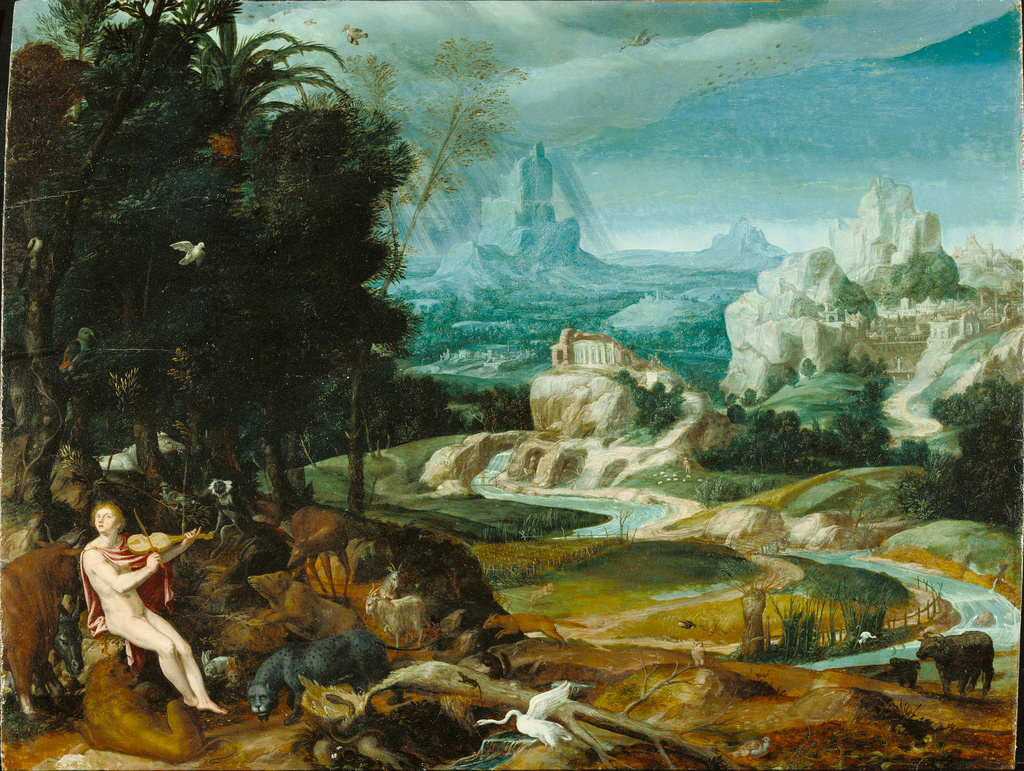
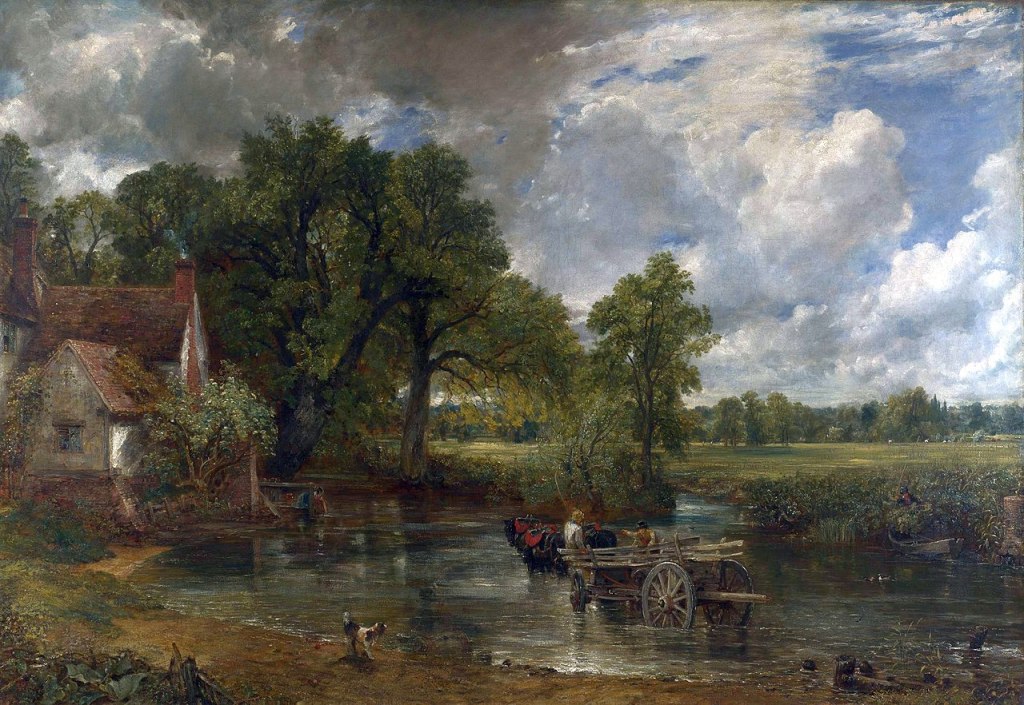
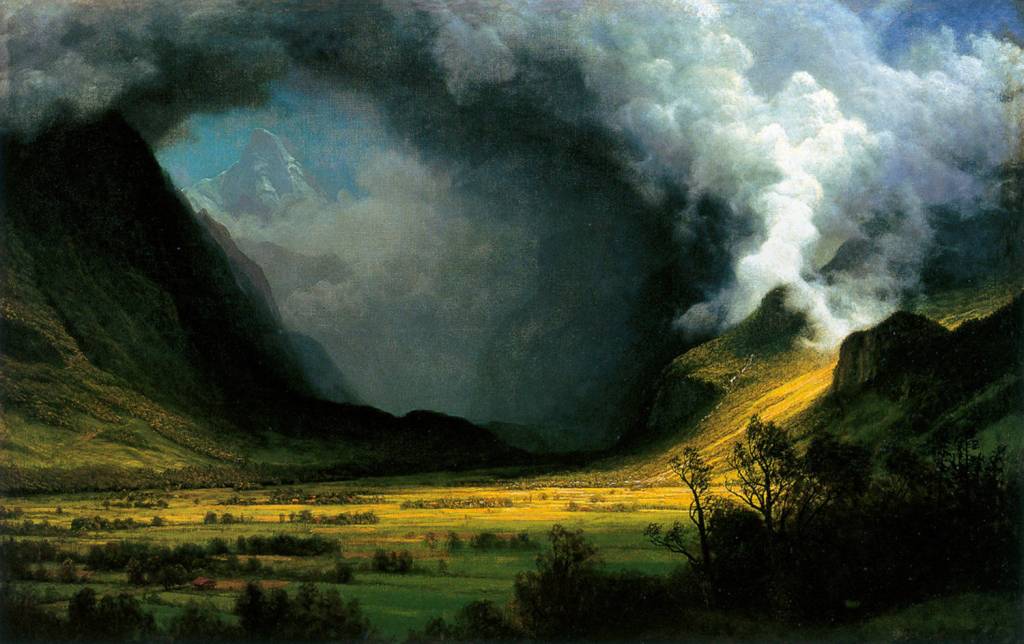
The taxonomic comes from European art history and refers to a painterly practice that gathered pace in the 17th and 18th centuries. They were either fields for noble actions or cultivated gardens inhabited by gods and or heroes.

In Holland new wealth celebrated property ownership. The English art world soon followed suit.

There were four types of landscape painting.

  1. Noble
Landscape with Orpheus (Unknown c1570)

2. Picturesque.

John Constable Haywain 1821

3.Sublime.

Storm in the mountains Albert Bierstadt (1870).

4.Mundane.

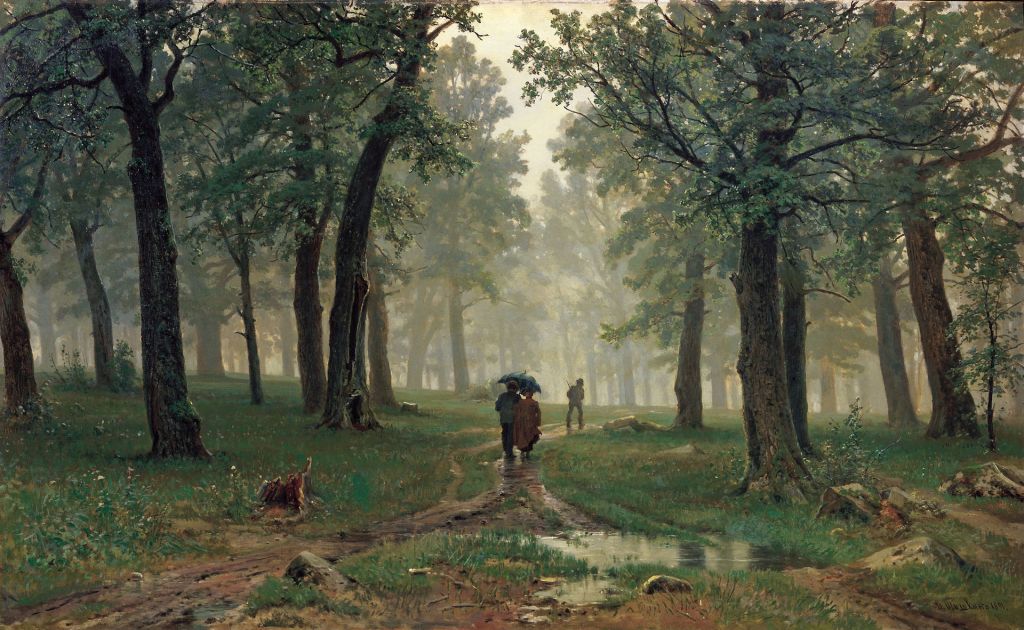
Rain in the Oak Grove Ivan Shishkin (1891)

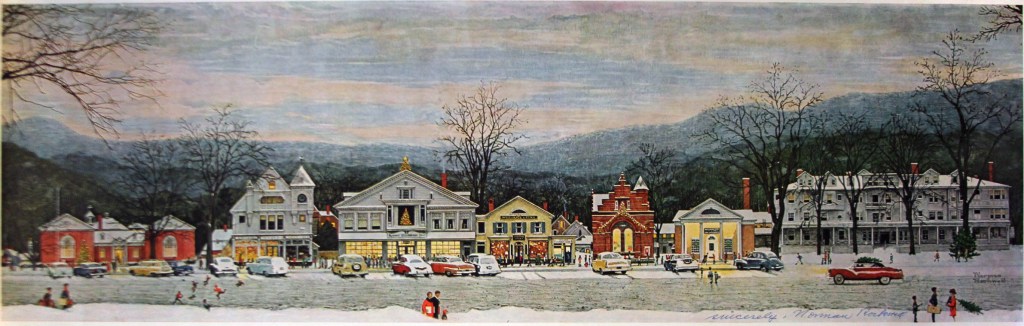
Later in America (6)Norman Rockwell painted a main street showing “small town America”. Middle America the ruling mercantile masses want to show their identity in a national context. LS Lowry did the same in the UK but for the working classes. It excludes minorities only showing “normal”, straight people, excluding many from this idyll. This progressive era shows the antidote is a nature experience over the unhealthy urban life.

Stocksbridge Main Street at Christmas Norman Rockwell (1967 Norman Rockwell Collection)

Wild places began to be seen as god’s gift to the American (White people) to be preserved as a gift for future generations. Kenneth Erikson points out these places are ceremonial with codes of conduct (Park rules).

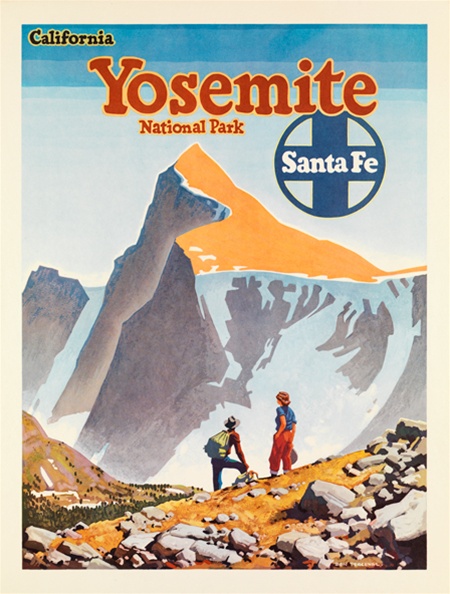
In 1908 69000 tourists went to worship in the eleven national parks by 1928 this had soared to 3,000,000. They were attracted by Posters, Postcards, Railroad adverts, Magazines and landscape art, not by the wilderness itself. The indigenous people were never shown as part of this landscape if they were they were a conquered novelty.

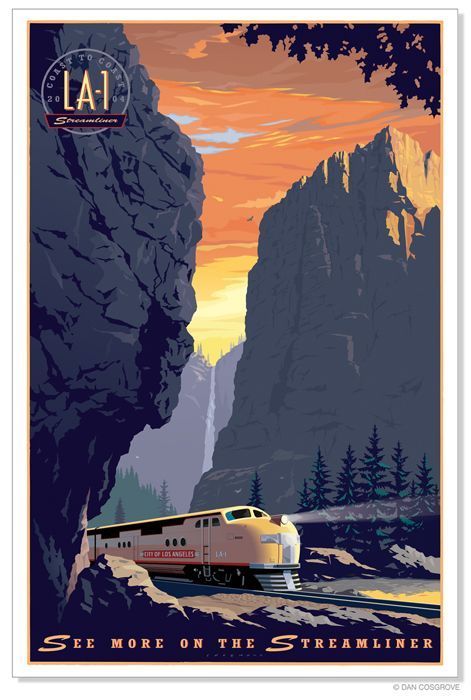
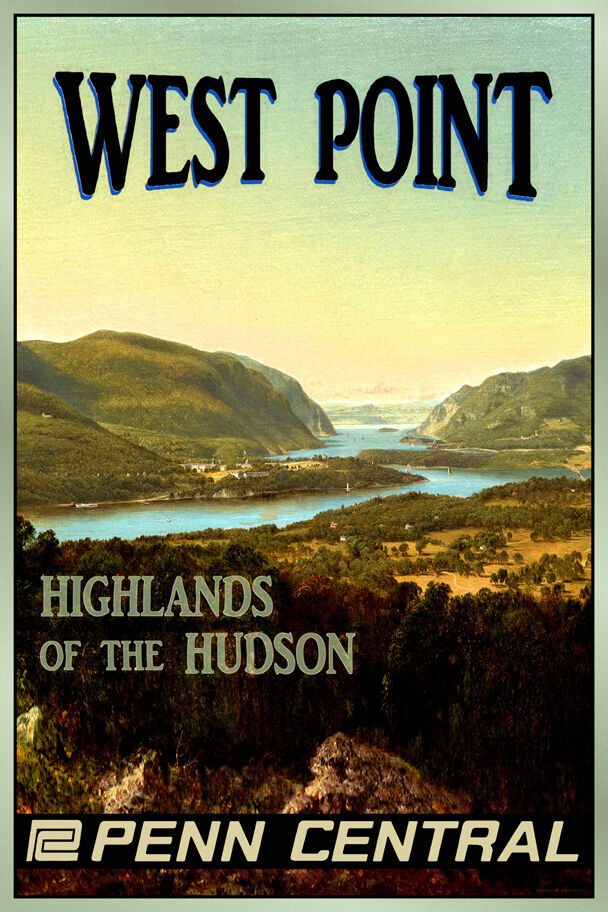
Railroads trumpeted their own individual routes as better than others using lavish posters and claims to do so. The demand for material to support this gave a boom to photography. Huge posters encouraged city dwellers to go out into the country to find the “Real Thing”.

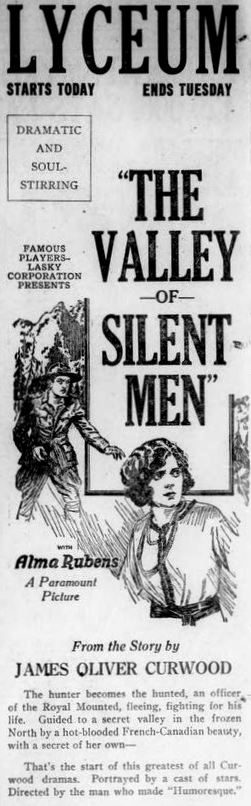
Cowboy movies used the wild landscape as a backdrop to the onscreen action. “A man must be a man just to survive”, read the poster for the film the “valley of the silent men (1922).” This countryside was used to sell things as diverse as cigarettes to presidents.

Newspaper Advert for screening of a film at the Lyceum (1922).

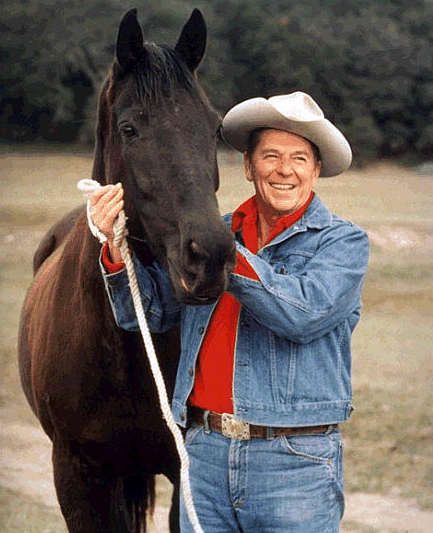
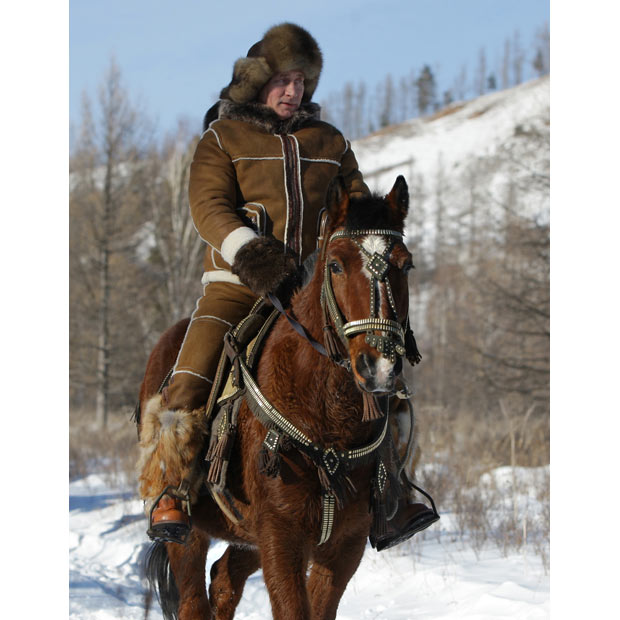
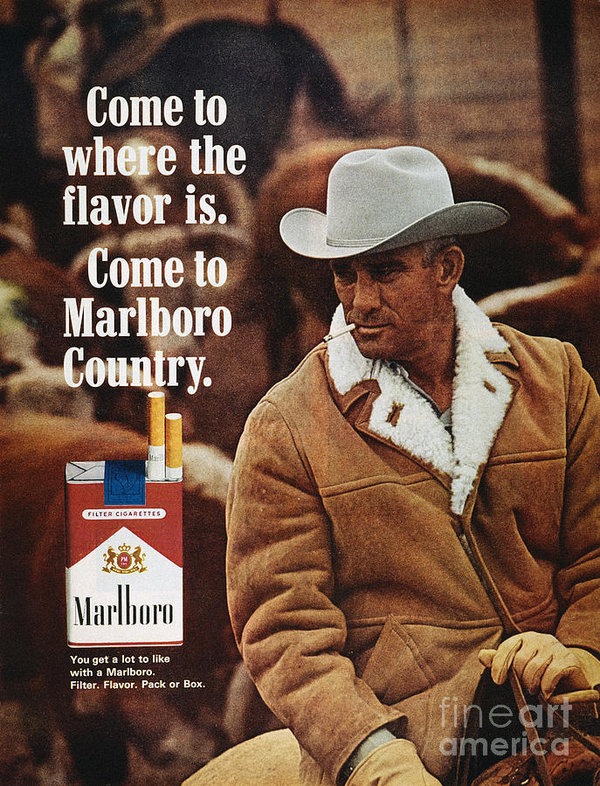
Like Marlboro Men posters used to sell tobacco Ronald Reagan in White Stetson rode horses and chopped wood to show he was a man of the nation. Putin does the same sort of thing in Russia riding horses with his shirt off or in furs in mountains.

Liberal ownership sells too, Camping equipment, Holidays, Walks, Bikes and Boots along with all the other paraphernalia we need to go into the wilderness. Even today you only have to look at Windermere to see city dwellers venturing out in Kagools and boots around the town some venture no further than the towns streets.

US art photography developed from the “straight photography” of Stieglitz and Weston. Ansell Adams took it one level further portraying a primordial Eden. Minor White reviewed Stieglitz work “Equivalence”; he said “a photograph is a metaphor for the feelings of the artist”.

Aperture school was overwhelmed by the curatorship of John Swarkowski. (Here is that name again). He respected the work of Timothy O Sullivan in the civil war. He didn’t show straight images but the feeling in the scene. He curatted “American Landscapes”, in this work he included two women Laura Gilpin and Dorothea Lange even though many more women were practising at the time. He used one image from each woman whilst using four each from Edward Weston and Harry Callahan.

New Topographics tried to capture the feel of a scene. Old tyres, broken concrete, Jet plane contrails and Oil installations. Showing the chaos that underlines the ordinary lives of Americans.

In the 1970s photographers tried to hold the companies back who were exploiting the landscape by destroying their resources. However the big galleries and museums were funded by the same companies that were exploiting the land. Making funding of Art projects difficult to obtain and muting any dissident voice which spoke against them. Landscapes contain resource does the re-landscaping after the resource is taken make taking them right?

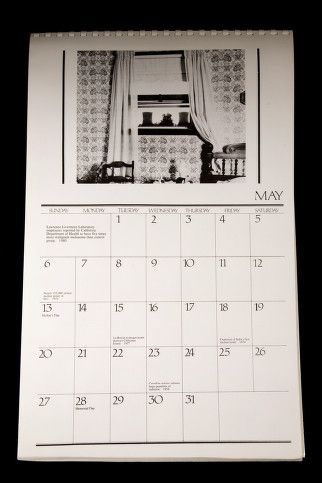
Lucy Lewent Three Mile Island Calendar (1964)

Images showing views “Three Mile Island” nuclear power plant and putting on a well researched calendar is a superb idea photographed by Lisa Lewenz. Selling the calendar for $6 made it available to all and bypassed the major sponsors of art. The voice wasn’t silenced.

The exclusion of women from the art world at this time wasn’t the same sort of prejudice. If we remove the big company sponsorship from art would it remove this censorship of art projects? The work should be on show for being good enough not because of who produced it. After all excellence has no race or gender.

However does running an all female issue of a magazine or competition put these old errors right. I think all the practitioners wanted their photographs accepted because of the merit of the work not because of the exclusion of others.

I chose to review Dorothea Lange’s photograph “Towards Los Angeles” in assignment four not because she is a woman but because it is a superb image.

Work Cited

Bierstadt, Albert. Gathering Storm in the Valley. 1891. Oil on Canvas. Nordsee Museum Husum.

Borzage, Frank. The Valley of the Silent Men. Black and White Cellulose, Western. Paramount Pictures, 1922.

Bright, Deborah. “‘Of Mother Nature and Marlboro Men.’” Accessed September 15, 2020.

Constable, John. The Haywain. 1821. Oil on Canvas, 130.2 cm × 185.4 cm (​51 1⁄4 in × 73 in). Room 34. The National Gallery, London. https://www.nationalgallery.org.uk/paintings/john-constable-the-hay-wain.

Leweng, Lucy. Views of Three Mile Island. 1967. Printed Calendar. Railroad Posters. 1960s. Varous On Magazine and Trains.

Rockwell, Norman. Stockbridge Main Street at Christmas. 1967. Oil on Board, 26½” x 95½”. Norman Rockwell Museum.

Shishkin, Ivan. Rain in the Oak Grove. 1891. Oli on Canvas, 203 x 124 cm (6’ 7.92″ x 4’ .82″). Tretyakov Gallery (Moscow Russian Federation).

Unknown. Landscape with Orpheus. 1570. Oil on Canvas, 35.6×45.7cm. 71.PB.64. John Getty Collection. http://www.getty.edu/art/collection/objects/604/unknown-maker-flemish-16th-century-landscape-with-orpheus-flemish-16th-century-about-1570/.

Excercise 4.3 Subjective voice.

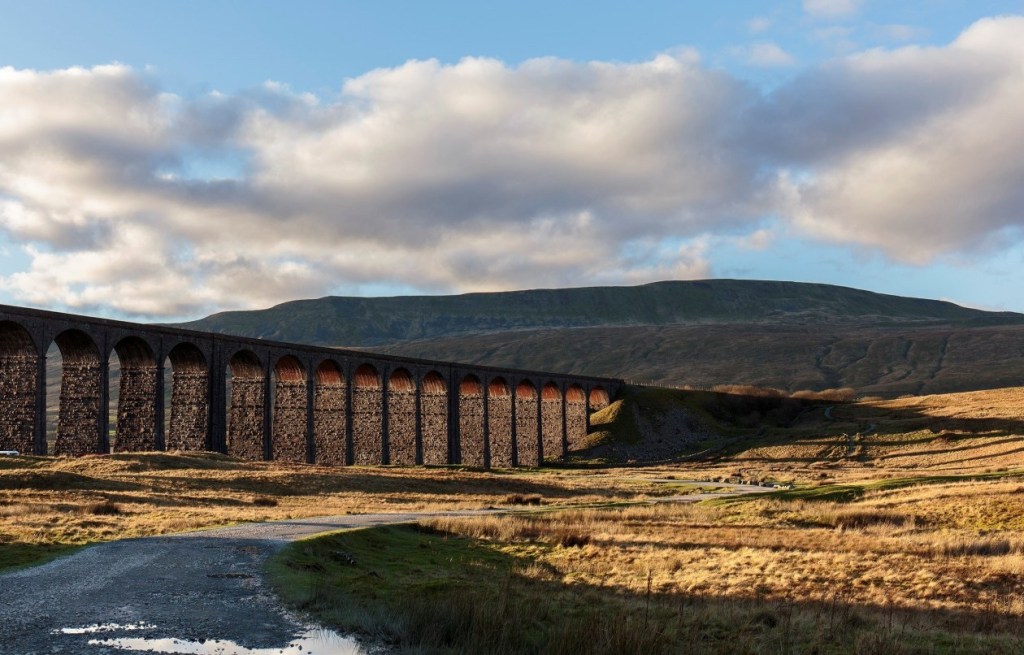
I was introduced to the landscape at the age of about eleven when I completed the Yorkshire Three Peaks walk. These three hills felt like Everest to me at this time.

Whernside.

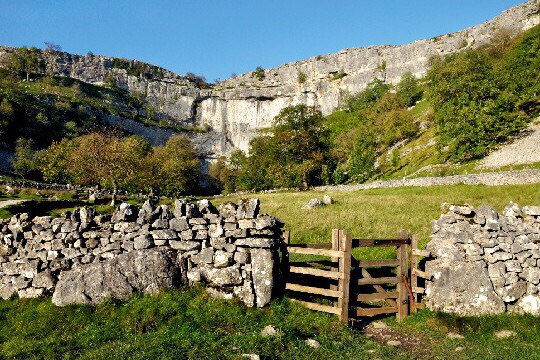
I went on to complete Duke of Edinburgh Bronze and Silver and had to complete proper hikes in both these awards. Navigating from Malham to Threshfield was a great introduction to using a compass.

Malham

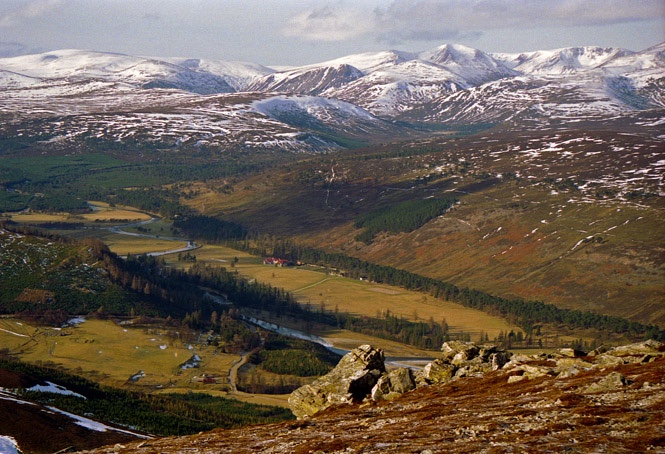
At Eighteen I joined the Navy and took part in the Ten Tor’s in Devon another real test. Then on to Four days survival training in the Brecon Beacons. Living from and with nature was a real test. I learnt so much about the landscape and myself through all of these experiences.

The Cairngorms
The Brecon Beacons

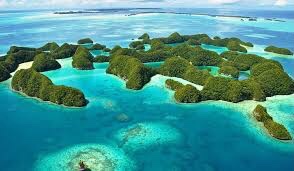
After leaving the navy I continued my diving and travelled all over the world pursuing diving. From the mountains of Scotland to the Rock Islands of Palau and countless landscapes and seascapes between I have seen some of this planets wonders. Note I say some.

Rock Islands Palau

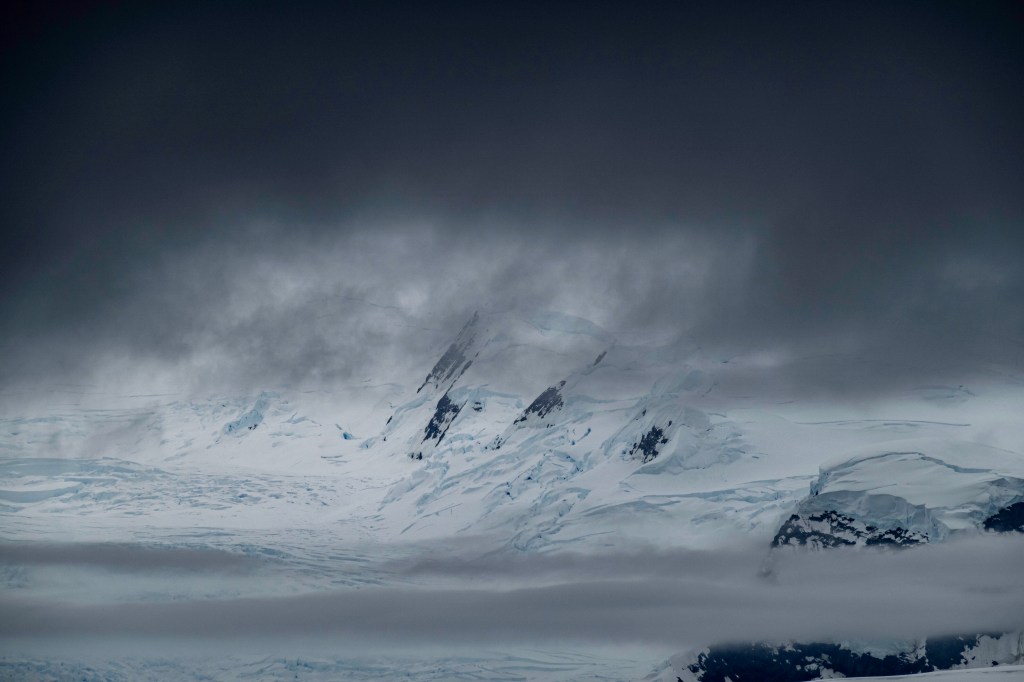
Recently I have been in Antarctica and the Arctic this takes me to the last wildernesses on our planet. These places have had a huge effect on my life, they are huge but oh so fragile.

Antarctica

I am no eco warrior but try to live my life to the best standards I can. Mending things rather than buying new. I walk to the shops instead of driving the car. I try to minimise the waste I produce to protect our fragile world.

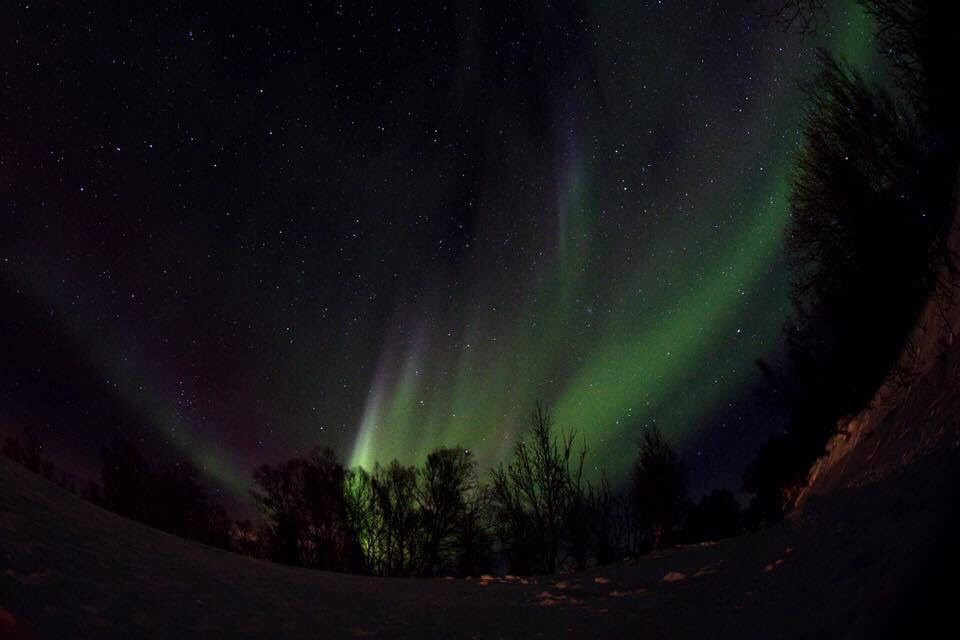
Northern lights.

Some of my best experiences have been sitting up, in my sleeping bag looking at a cloudless night sky. And watching the Northern lights in Norway and Greenland.

I am fascinated by the animals in these places but don’t want be a scientist. I just enjoy knowing they are out there.

The people I have met can teach us so much from the man in the jungle who knows which plant treats what, to the Micronesian sailors who use sticks to navigate the vast Pacific Ocean. I hate when good meaning westerners want to introduce air conditioning, Coca Cola and the internet they don’t need it……..in my opinion.

Exercise 4.2 Landscape for everyone.

Landscape was a route to levels of emotion which were acceptable without being too nationalistic. These words sum up for me how we are in England fiercely proud without wanting to offend.

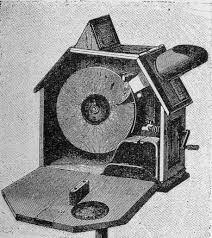
The Mutoscope imagined to look down on England’s history.

CFG Masteman wrote “looking down on England” in which he looks at landscape from the medieval jungle through the renaissance to the black blots of the industrial revolution. He uses a clever vehicle “the Mutoscope” for looking down on the landscape to see the changes in historic periods like a sped up film.

In 1940 the threat of invasion came from across the North Sea and Germany.

“Unconquered for a thousand years” is a phrase I find interesting as Germany talked about the Reich lasting a thousand years. We looked back they looked forward.

Patriotic propaganda talked about community in the village led by the Squire bringing people close to the past and nature. The inhabitants removed signposts and addresses from the scene to aid confusion to the enemy.

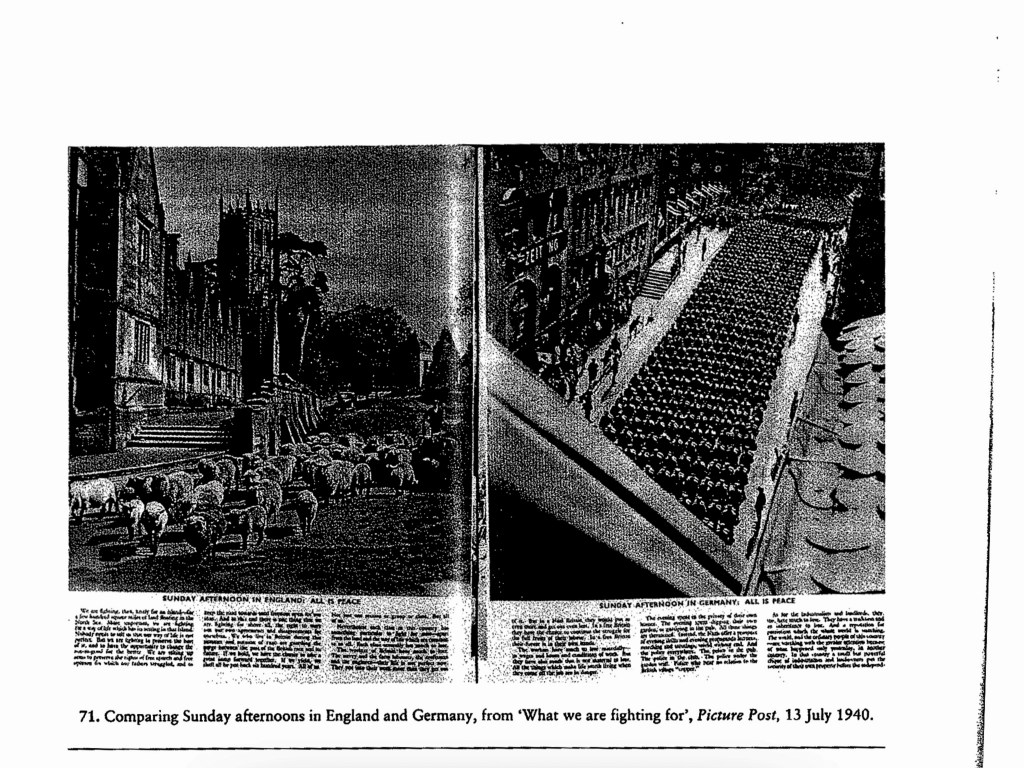
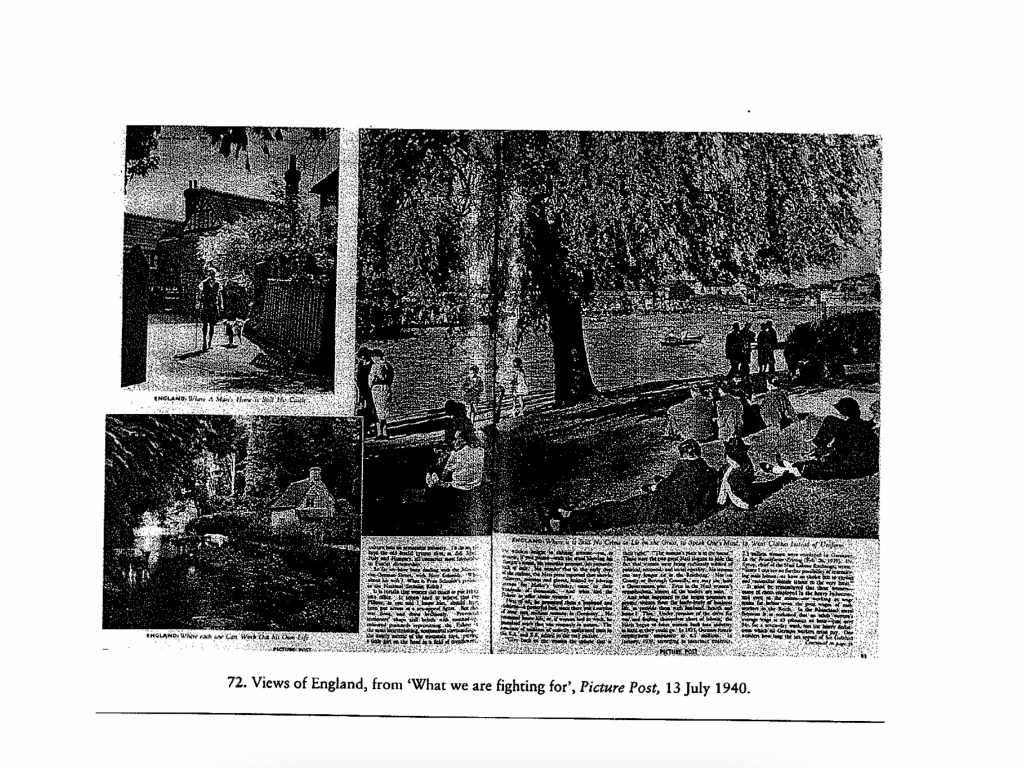
What are we fighting for.

The landscape became travelled through rather than enjoyed. Publishers such as the Pilgrim Library published books showing the idyll of previous landscape to remind people what they were were fighting for.

Picture Post juxtaposed photos showing a boy playing cricket in one then a young German boy in Hitler Youth uniform. Democracy against Militarianism. Another shows a half timbered cottage with the caption “England: Where a mans home becomes his castle”, all hint at what is being fought for.

What are we fighting for?

Civilians being bombed were shown with upturned faces showing their bravery and hinting at a brighter future once the turmoil had been endured.

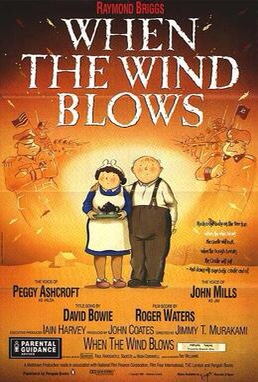
Completing this made me think of the illustrated book by Raymond Briggs called “When the wind blows”. The same emotions were used to show how a nuclear attack would effect our grandparents who were from a simpler time. This made me want to absolutely defend them.

Promotional poster for the animation of the book.