Michael Green
515037
Landscape, Place and Environment.
Assignment 5
Evaluation of my work.
Response to Caspar David Friedrichs The wanderer above a sea of fog (Friedrich,
Photography is different to painting as the instrument captures what is in front of the lens, editing allows you to bring out the features within the photographs. Painting allows the artist to add features or change perspectives to apply the sublime to a drawing or painting. I tried to capture peoples reaction to a sublime scene in front of them. Friedrich could add people to the scene back in his studio. Creating rather than recording.
I have seen a spiritual reaction to the landscape in Antarctica. Not a religious spirituality but people in a wilderness setting being stopped in their tracks and responding to it by sitting or standing then staring, spending time taking in their feelings.
I have spoken to many of these people after they enjoyed their experience. People from all parts of the globe and of different faiths. They all use words that are related, insignificant, small, overwhelmed, amazed, moved and best of all transcendent. The way they just stop and stare makes me think of Friedrichs painting of the wanderer. One person who had terminal cancer and had only a short time to live said this experience had given their whole life meaning. They could leave this life now fully enlightened.
Friedrich said “All authentic art is conceived at a sacred moment and nourished in a blessed hour, an inner impulse creates it, often without the artist being aware of it”. (Friedrich, 1837). The painting certainly shows a sacred moment captured in time, I have certainly missed many of these moments just has the quote says.
The Theologian Ludwig Gothard Kosegarten who influenced Friedrich said “Nature is Christ’s Bible” (Kosegarten, 1815) again a religious connotation which I tried not to portray in my work.
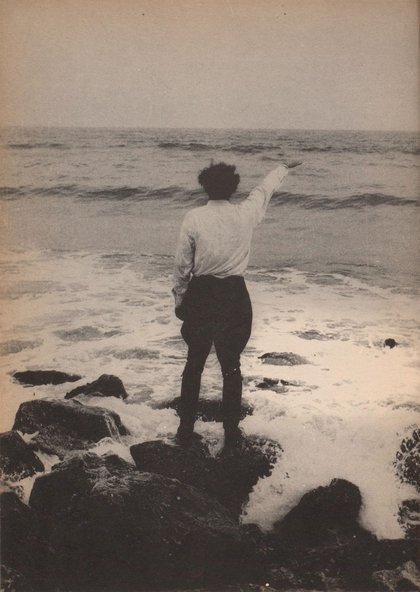
It was easy for the Nazis to hijack Friedrichs work he showed Germanic themes, Aryan people looking at the distant horizon was employed to show Germany looking across difficult times to a brighter horizon. In the 1960s Anselm Kiefer completed “Occupations” (Kiefer, 1969) a body of work based on the Sieg Heil salute used by the Nazis. He posed at various relevant sites including one at the German coast which echoes “The Wanderer above the fog” (Friedrick, 1818). Keifer who had seen the romantic in the ruined cities after the war countered what the Nazis brought to Germany. I certainly didn’t want to portray these ideals.
My work consists of 15 exposures taken from 60 shots taken. They are influenced by Friedrichs work but not copies of it. I wanted to capture the feeling not the painting. When I proposed this work initially my tutor encouraged me not to produce a photobook but to take control of the whole process. He suggested Japanese Stab Binding.
This meant I had to learn a new skill and after practising by making a small notebook I progressed to producing the A4 book for this assignment. I enjoyed this learning immensely and I like the finished book. I even made a window for Caspar David Friedrichs painting to feature.
Both my tutor and I like maps so it seemed sensible to include a map of where the images were taken. I added a page of text to give the viewer some idea of where the inspiration for the work had come from before they looked at the finish result.
I enjoyed the whole process but seeing people experiencing the landscape was the most enjoyable. Placing myself where I thought people would stop and then waiting made me think of Henri Cartier Bresson and the decisive moment. Then back at home, the process of producing the book was extremely satisfying.
If I was to approach this work again I would think more about lighting. The weather was not kind to me with many overcast skies. However with the right setting on my camera they add a mood to the exposures. I didn’t include the exposures that showed a man who stripped to his underpants and sat down in the snow and cried. Or the skateboarder who got out his board and did jumps from a rock. They didn’t fit the brief of the Rucksfigur. Finally I change the painting on the cover by changing it from a portrait layout to a 3:2 Landscape format, this takes away from the height Caspar David Friedrich wanted to portray in his painting.
If I was to change anything I would change the weight of the paper I used to a lighter figure. The thickness of the paper restricts opening the book. It doesn’t restrict when observing the book normally. However when I photographed the pages it was hard to get the paper to lay flat meaning the photographs of the work have a distortion. This is only a small thing caused by not being able to send the work in for looking at normally.
I feel the finished work achieves the things I set out to achieve. Showing the spiritual experience that nature gives. Without affecting the adventure the subject was enjoying. The finished book feels right and shows the exposures as I envisioned at the start. Opening each page shows a new experience, a new reaction or a new adventure.
Works Cited
Friedrich, C. D. The Wanderer above the sea of fog. Kunsthalle, Hamburg.
Kiefer, A. Occupations. Tate Modern , London.
What Great Paintings say. (2010). Koln: Taschen.
 Michael Green Landscape Studies