Whilst researching the Farming Security Adminstration (FSA) led by Roy Stryker for Assignment 4, I came across the name Gordon Parks a name I had never seen before. Below I document some of his work within photography but I hasten to add only a small part of Gordon Parks life as he had a full and varied time.
Gordon Parks was born into an African American family on the 30th of November 1912 in Fort Scott Kansas. He was the youngest of 15 children. At the age of 15 he was thrown onto the street. He supported himself playing piano and working in the bars and brothels of his home town. He also did a smaller amount of singing in the bordellos too.
Age 25 he bought an $8 camera and taught himself photography. Eventually he took some photos at a Harlem fashion event and the wife Boxer Joe Louis saw Parks work. She was so impressed she invited Gordon Parks to move to Chicago where she helped him set up a portrait studio. He documented African American life. This work led to a Jules Rosenwald Fellowship which paid him $200 per month to help support his family.
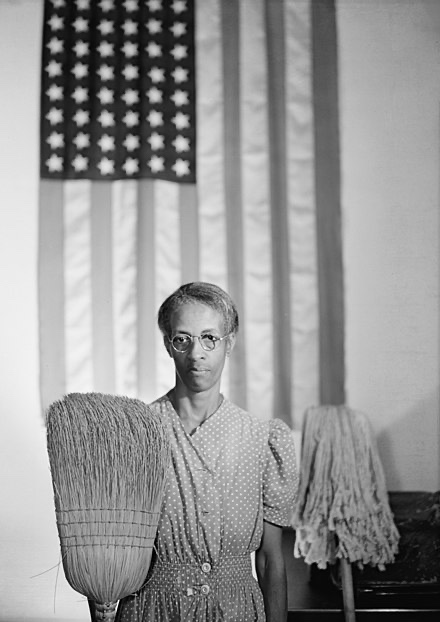
Parks work ended up presented to Roy Stryker the director of the FSA, who employed him and took him under his wing to ensure the organisation got the best from Parks skills. On his first lone assignment Stryker instructed him to go and photograph a cleaning woman of African American origin. Parks knew of just such a woman in the FSA building The ladies name was Ella Watson he saw and placed her in front of the Stars and Stripes flag in the entrance to the building. And called the photo “American Gothic Washington” (1942). This image shows a lady who is the back bone of the United States, unseen, stoic and determined. Much like the earlier painting by Grant Woods which I must mention now entitiled American Gothic (1930).
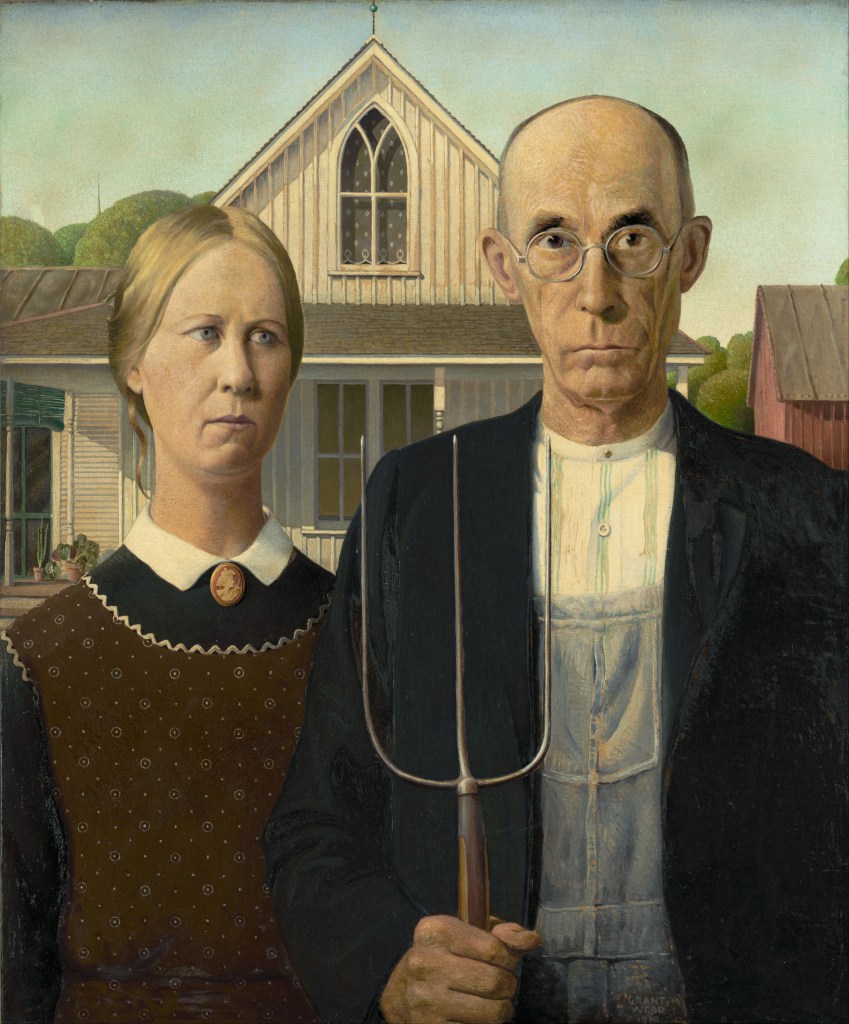
Grant Woods was a painter in Eldon Iowa. He looked around his town for inspiration and saw the Dibble house. He was inspired by the American Gothic window in the upstairs of the house. Woods biographer Darrell Garwood (1944) writes “Wood thought it a form of absurdity to include a Gothic window in such a structure”. The building forms the background of the painting whilst the main subjects are Woods own daughter and his Dentist. It is interpreted as either a depiction of the stoic pioneers of the west or a reference to the loss of his father at an early age. Much as Parks wanted to show in his image later. They both have a strong message by a subtle humour.
Parks took many more images depicting mainly African American life for the FSA. He even took other images of Ella Watson. The FSA was wound up and Stryker went to work for Standard Oil Photography Project. Stryker asked for Parks to join such was their friendship and respect for one another. Stryker was told he could not employ Parks so Stryker resigned. The powers that be relented and Parks and Stryker worked together on the project at Standard Oil for several years.
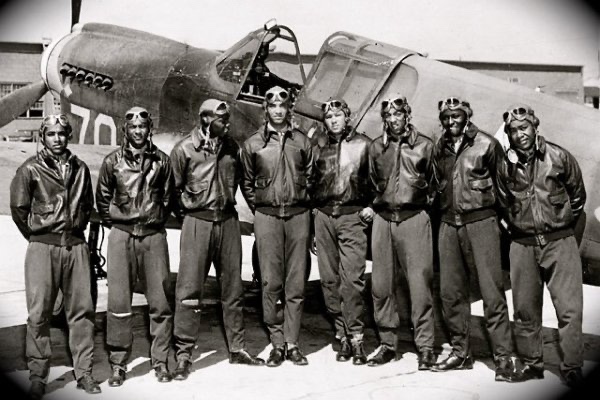
During the war Parks was embedded with the 332nd Fighter Squadron (1942, US National Park) where he took many photos documenting this all African American fighter squadron. This helped to show the segregation even in times of war but more importantly to me shows the joint effort and suffering endured to gain an eventual victory for a promised better future.
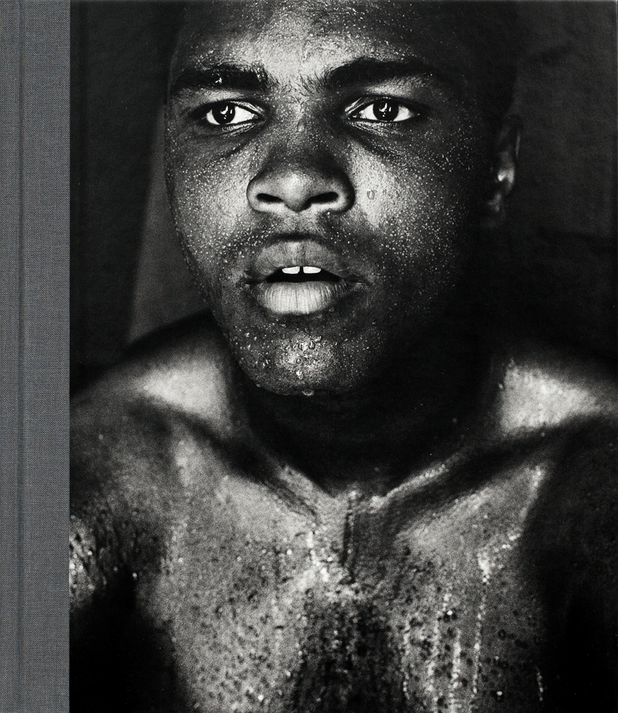
He worked for Vogue Magazine he drew on his past experiences gained in the Portrait studio to capture striking shots of his models. He then worked for Life magazine where he shot Barbara Streisand, Stokely Carmichael, Malcolm X and Mohammed Ali capturing the essence of all who came before his lens.
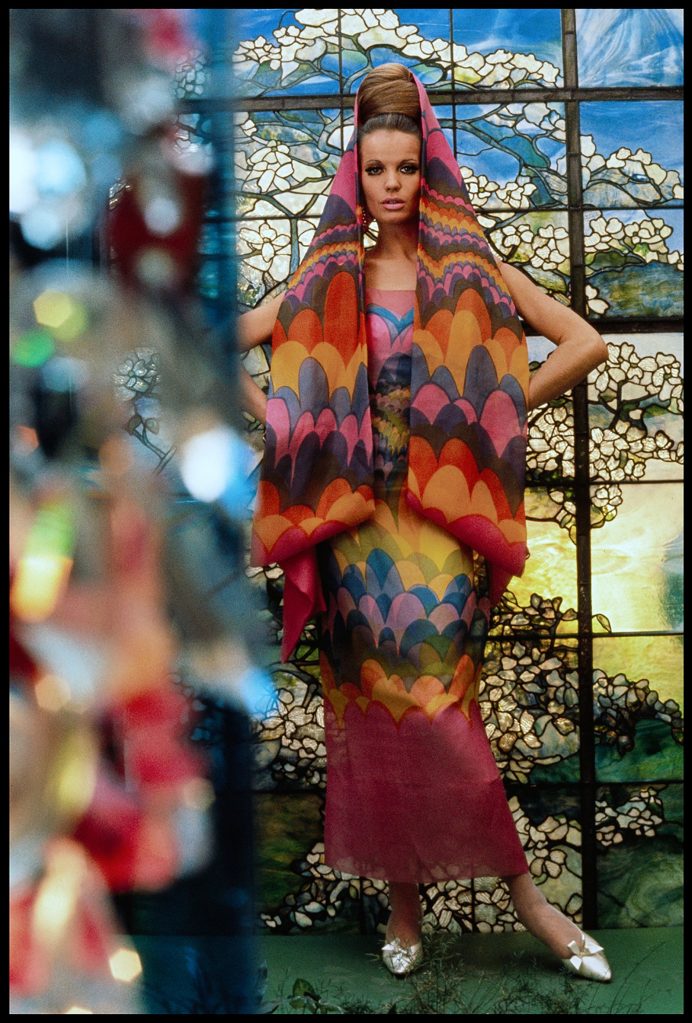
One writer said of him “He became one of the most provocative and celebrated photographers in the United States”. (Baker, 1992). Parks was made Photographer of the year by the American Society of Magazine Photographers. An Accolade that meant very much to Parks.
In the early 1960s her worked directing a stylish police film called “Shaft”, and recently he made a cameo in the sequel sat playing chess in the background of a bar scene. He never lost his love for music and in 1963 so around the same time as he worked on the above film he wrote the music for a ballet entitled “Martin”, the subject of this ballet is Martin Luther King who was assassinated earlier in the same year.
Gordon Parks died on the 7th of July 2006 he was and is a truly inspirational person. He took life by the scruff of the neck and made magic with whatever he decided to do be it with Music or Photography he threw himself it each with equal aplomb.
Why have I never heard of him before?
Works Cited
Baker, Lee D. “Transforming Anthropology.” 13, July 1, 2008.
Craven, William. American Art History and Culture. One. McGraw-Hill Education, 1993.
Garwood, Darrell. Artist In Iowa A Life of Grant Wood. W.W. Norton & Co Inc New York, 1944. https://archive.org/details/in.ernet.dli.2015.89523/page/n131/mode/2up.
Gordon Parks. American Gothic Washington. 1942. Silver Gelatin Photograph, 11 13/16 x8 7/`6 Inches. https://collections.artsmia.org/art/100557/american-gothic-washington-d-c-gordon-parks.
Parks, Gordon. “Veruschka.” Vogue Magazine March 1965, 2965.
US National Parks. “Afican Americans in WW11.” US National Parks, 1942. Office of the War Department. https://archive.org/details/in.ernet.dli.2015.89523/page/n131/mode/2up.
Woods, Grant. American Gothic. 1930. Oil on Board. Art institute of Chicago.
 Michael Green Landscape Studies