I am a level 2 student with Open College of the Arts. I have been interested in photography since attending college in Leeds in my teens. I spent hours in the college library looking at photography books showing varied subjects, history to autopsy photographs. The ones that interested me most linked photography with Art.
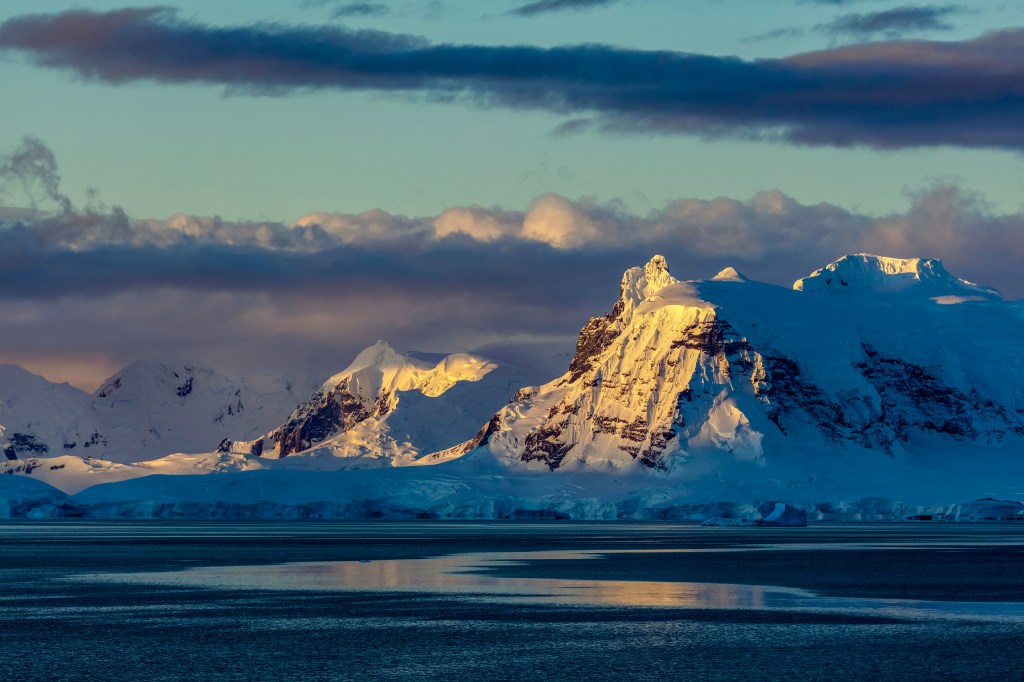
Recently I have been fortunate to visit Antarctica. I tried to capture the scale of the landscapes in Antarctica with varied success. Whilst thinking about these landscapes I saw people having a spiritual experience as they observe the scale of this place. These spiritual moments made me think of Caspar David Friedrich and his painting “The wanderer above the sea of fog”. This painting depicts a person having a reaction to the landscape before them. I see this same reaction in many of the people who witness the landscape in this polar place.
I find it fascinating watching people taking selfies as I did in a previous course. Equally beguiling is the way this landscape has the power to stop you in your tracks. I used my compact camera allowing me to carry it wherever I went and enabling me to quickly deploy it to capture these moments so I can share them with you.
John A Walker’s (Walker, 1980) essay was a revelation to me. I found it extremely interesting to think of the different contexts one photo can inhabit.
He starts talking about a wedding photograph and how its meaning changes just by taking it from a wedding album and placing it in a photographers window. This one photograph goes from a family memento to an image showing the skill of the photographer.
Then he writes about Jo Spence (Spence, 1978) and her photos taken over forty years and how these ordinary photos take on different meanings when shown in a feminist journal. It was interesting to look at these images and think about how the meaning of the images changes with a change of context. If you put them in a glossy magazine or a feminist journal. They go from strange and quirky to photos that make me consider the plight of the female. This is achieved by taking the photos from the private to the public context
Next he looks at Peter Marlows National Front Steward (Marlow, 1979) this photo shows a strong young man, defiant and aggressive. To the right-wing he appears as a warrior, to the left-wing these characteristics are turned against him. This type of image featured in the propaganda of the nazis in the 1930s.
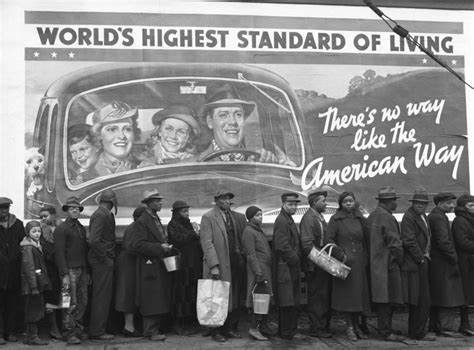
Margaret Bourke-White. Kentucky Flood 1937
I found it refreshing to see Margaret Bourkes-White (Bourkes-White, 1937) Photo feature in the essays. I had found this photo in my research for assignment 4. I had seen the same messages that Walker discusses in his piece of writing..
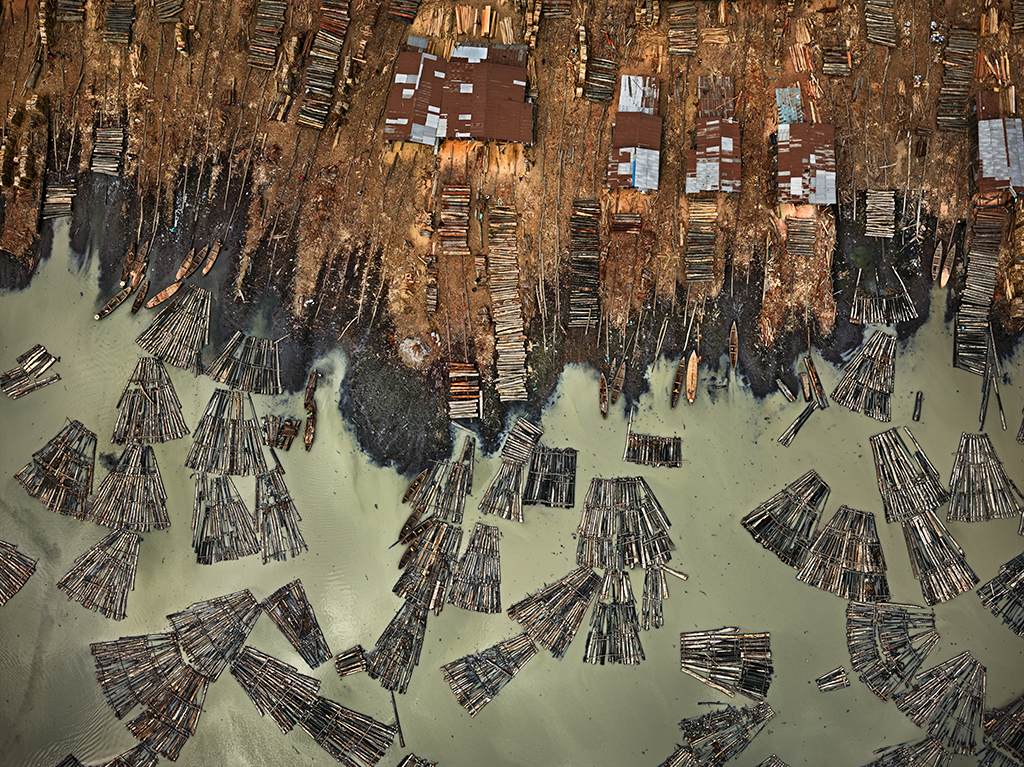
Edward Burtynski Sawmills 01 Lagos 2016.
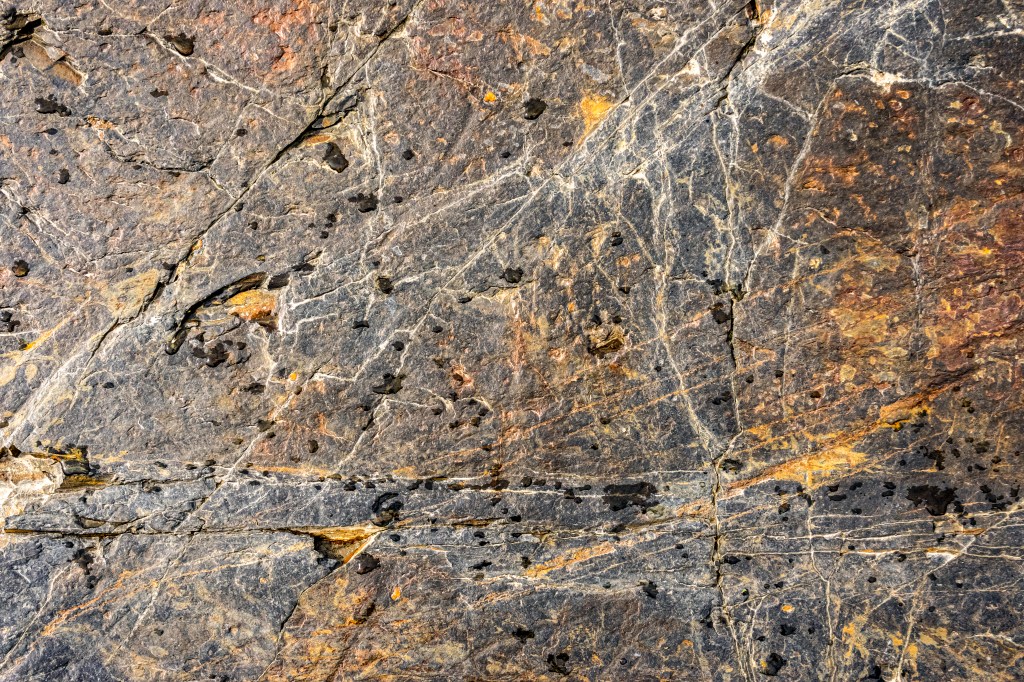
Reading all this essay made me think of the series of images I had used for my slideshow in the previous exercise. Let us take just one and consider the different contexts. First though what is the photograph of It shows a close up of a rock face. It is colourful and I compare it to Burtynsky’s work. He shows sawmills from above and the damage this industry does to the landscape. (Burtynski, 2016). My approach is to show the landscape before the industry destroys it.
Michael Green, Antarctic Rock Face 2020
So the contexts I see are, first it is just a picture of rock. Secondly in the slide show it becomes an image within a series showing more rock. Third, It is my Background image on my iPad it makes the program Icons stand out. Fourth in an environment publication it would highlight the vulnerability of Antarctica and encourage its protection. Fifth place this image in a geological publication and it could encourage mining and exploitation of this fragile place. Sixth place it in a gallery printed large and it becomes a piece of art with its form and colours.
One of the contexts mentioned above is of a slideshow. I saw how much ice is disappearing and thus how much rock is becoming exposed. This exposed rock is full of minerals. They are protected now but in 2038 the Antarctic Treaty is up for renegotiation. We should start to lobby now to prevent damage being done to this place to retrieve these minerals.
Six different contexts with very different meanings from one photograph. When I took the exposure I hadn’t thought about any of this.
As photographers we need to consider the different contexts but we must also be aware that we don’t control the contexts others place onto our work.
Works Cited
Bourke-White, M. The Kentucky Flood. Art and Artists. Whitney Museum of American Art, New York.
Burtynski, E. Saw Mills 01 (Lagos). Edward.Butynski.com. New York.
Marlow, P. National Front Steward. Camera Work. London.
Spence, J. Facing up to myself. Spare Rib. London.
Walker, J. A. (1980). Context as a determinant of photography. Camera Work, 5-6.
This exercise was great fun to complete. It felt to me like telling a story and supported my thought process out in the field.
On a visit to St Andrews Bay in South Georgia I saw a beach with 100,000 breeding pairs of King Penguin and 5000 seals. They arrive on this beach within a few days of one another and return to the sea just as quickly once they have all bred and raised young.
Earlier in the course I had read about Roger Fenton (Fenton, 1854) and had seen his photographs of the aftermath of the charge of the light brigade his photo shows cannonball on the road used for the charge. This started me to think of the aftermath of the visit of the animals at the site I was to visit.
Roger Fenton Valley of the shadow of death 1854.
So I started by creating an outline of the kind of shots I would like to tell the story of the aftermath. The shots will not be easy for the viewer to see as they show all the gruesome aftermath much as those used to depict a battle.
I will open with a shot of the site fully populated by the breeding birds and then later in the season look for shots showing the suffering the creation of the next generation produces. I took sixty photographs over the next three months.
On my return home I looked at these exposures and got the list of ones I wanted to use down to twenty. The extra forty are duplicates of the same shots so are not needed.
I looked at several slideshows including the one in the course work by Andy Adams (Adams, 2013). I didn’t want to subject my viewer to 18 minutes. The duration I could comfortably watch was around three minutes so that is my target duration.
Another that stood out was Hunter Noack (Noack, 2017) and the Slideshow entitled In a Landscape. This slideshow tells of a classical concert about the landscape. It shows photos of the concert and people enjoying music in the outdoors. It is two minutes long and I felt comfortable watching for this duration.
This means each exposure in the slideshow will be visible for four seconds. This gives a total run time of just over two minutes. This should leave my viewer wanting more. One of my key aims in producing this work.
I used Photoshop to edit the images and then transferred them to my iPad where I used movie maker to produce the show. The process was very easy to follow and the instructions were informative and helped me add titles where I wanted them.
Next I considered music. I tried Sinfonia Antarctica No 7 by Vaughn Williams (Williams, 1952). It worked to a degree but was too long and a little too dramatic. I had made a series of recordings of animal noises and the sound of the sea and wind on my iPad so I tried these. They work perfectly and will allow me to add commentary so the viewer understands what they are looking at.
Last I played with titles I kept this as short and simple as possible just giving the location at the beginning and ending with the words “Until next year” to make it clear this will repeat every year.
Below you will find a link to my work, click on the link and the file will open on your system,please feel free to comment and let me know if what you think of my approach to the subject.
I read the article written by Sharon Boothroyd (Boothroyd, 2020) and agreed with her observation that it was professional looking. I wondered though what I had gained and lost with the experience?
Andy Adams (Adams, 2012) has curated an interesting,beautiful and an entertaining slideshow. With some great images in recognizable styles.
I felt the slideshow was a little long at 18 minutes but stayed the course and overall enjoyed the experience. It certainly showcased many artists and their work. The accompanying words added to the experience and I noted quite a few names for me to look at after the show.
Not being able to spend more time with some shots and less time with others was frustrating at times. However I went back and paused to look with more detail at both shots I liked and liked less. However when paused the detail suffered and I wasn’t getting the best I could from the work being shown to me.
Therefore this would work well if accompanying another format say a book or as a trailer for an exhibition. It would work well to tease me to seeing more. I enjoyed it though. The different artists use of irony and humor made the show very watchable.
The film was lacking sound or commentary and the fact the film is so long made it feel a little sterile to me. Just a few sound effects or some words from the artist would have added a new dimension to the piece of work I watched.
I wonder about commentary but I am not sure if the world is ready for my Yorkshire accent but will experiment when I make my slideshow.
I think my slideshow will be called aftermath and will show the aftermath of a breeding season of a penguin colony. I will add sound and commentate over the images. I am looking forward to this one. However I will keep the time length down so my viewer wants more and is less inclined to become bored.
In this exercise we look at making a photo book using an online provider. I chose Blurb as I have used them previously during the course..
However I have always just used a straight forward template and played around with it a little. This time I wanted to start with a blank page and build the book from scratch.
I had also only ever created a photobook using my Ipad so this time I wanted to complete it on my PC so downloaded the software to get started. After reading the description as I waited for the download I thought this was going to be like having a clean sheet of paper. I was a little disapointed to start the process choosing page numbers and types of cover.
I started to upload my photos to the software. On the third one the software launched a pop up box and adviced me the photos were too large and I needed to make them smaller. Even giving me the dimensions recommended for the size of book I had chosen. This saved me lots of time as I stopped at that point and amended the photos .
After adjusting the dimensions using batch process in Adobe Bridge I continued to upload them to the book.
The software seemed difficult to use at first, but once I had completed five or six pages the layout became pressing F1 helped a few niggles.
Having placed the photographs on the pages I could easily move them around within the book just by dragging and dropping the pages.
Next I played with text, writing pieces for the inside of the dust cover and adding captions to each photograph.
Finally I used the auto align setting in edit to move everything so the words and pictures aligned correctly. It took me a few moments to find the spell checker and I couldn’t change the dictionary to English however that could just be because I didn’t find the setting.
Uploading was straightforward taking around 15 minutes. I checked it again and placed the order another nice touch was the email that arrived this afternoon giving me 40% off the total price of the book.
I chose to pay the £2.50 for a PDF copy which I will include below.
In this exercise I am asked to put together a quotation and comparison from three companies to get my images professionally printed. To get this done I will need to have a set of criteria to work to. I think that I must look at getting the print completed as big as possible so A3 or A2. I will look at C- Type printing and Giclee printing.
Before I put together the quote I think it would be useful to look at the difference to fully understand what is on offer from the companies I get quotations from.
C-Type printing or Lampda printing is much like a develop analogue print. Photographic paper is exposed to light to create a high quality print. It is almost a darkroom in a digital age. Quality photographic paper goes through the printer and is exposed to light. This light contains the data from a digital file. The source can be either LED or Laser light. After exposure it goes through a typical chemical process to fix the exposure. The paper can be Matte, Gloss or Metallic and the finished print is termed Archival and has a life of up to 40 years. The finished product will be of around 400 dpi.
Giclee printing uses a high quality printing employing 8 to 12 inks sprayed through a print head. This produces a high quality print however it will not be quite as detailed as the C Type print but will be of high quality none the less. The big advantage for Giclee is the number of papers available From Matte, Gloss, Super Gloss, Cotton, Textured and so on. You can combine this to create effects to bring the best out of you images. The finished product will be 300dpi.
Neither is better than the other they produce high quality prints we artists need to think carefully about what we want to say when we show our images. Using the right process can bring the best out of our work.
This first set of quotes is for C Type printing on A3 Matte paper with no mounting and no finishing coat. All prices include VAT. Paper weight is gm2.
Company
Place
Paper
Price
P&P
Spectrum
Brighton
Fuji Crystal Archive Matte
£8.88
£6.50
The Print Space
London
Fuji Crystal Archive Matte
£9.85
£4.35
Digital Lab
Newcastle
Fuji Crystal Archive Matte
£7.32
£6.95
Quotations for C Type Prints.
This quotation is for Giclee prints the size is A3 Matte paper with a weight of around 310gsm. The great thing with Giclee is the number of papers available this allows us to create different effects. For this quote though it makes it a little difficult to create a level playing field. So I used cotton rag as a benchmark to create this level playing field.
Company
Place
Paper
Price
P&P
Spectrum
Brighton
Cotton Rag Matte
£12.48
£6.50
The Print Space
London
Cotton Rag Matte
£12.96
£4.35
Digital Lab
Newcastle
Photo Rag Matte
£34.00
£6.95
Quotations for Giclee Prints.
Next we were asked to prepare a print to the specifications the company require to obtain the maximum print quality for one of the companies. I chose Digital Labs to prepare an image for their process. Their website required the following.
To get the best results please work in sRGB colour space ( please do not work in CMYK ).
Files should be supplied in 8-bit mode. We use Noritsu 3701HD and 3704HD printers and a Chromira printer for large format prints and these will only handle 8-bit files. When working with 16 bit files please change to 8 bit as the last step of your workflow.
All prints up to and including 18″x12″ (plus panoramic format prints up to 36″x12″) are printed on our Noritsu machines. Ideally these should be supplied at the required print size at 300ppi.(For good quality we advise at least 200ppi.)
All prints larger than 18″x12″ are printed on our Chromira 50 printer and these should be supplied at the required print size at 300 ppi. (For good quality we advise at least 200ppi.)
If you require large prints on our Chromira printer you can supply JPG files via our online ordering system or if you prefer to send TIF files please use the WeTransfer channel. When saved at a high quality compression setting (10-12) JPG files are perfectly acceptable in comparison with TIF files.
If you do send TIF files for very large prints please flatten your images and do not use LZW compression.
This image meets the criteria set by Digital Labs for Printing by both C Type or Giclee.
In the final part of the exercise I am asked to consider if an inkjet print is a photograph. I thought it would be good to consider the meaning of the word photograph. The word derives from Greek and translates to light drawing. Collins english dictionary (Collins, 2019) gives the definition:
The process of allowing light to fall on a photo sensitive material is within my camera with light passing through a lens onto light sensitive material, the sensor. It is then store and manipulated digitally and finally printed using an inkjet printer at home.
I feel this is most definitely a photographic process which produces an image. What I must decide is how I want my viewer to see the image. Unlike a film camera I can decide to create a chemically produced image or I can use many different papers to create the look I want to get the best from my images.
Some photographic competitions wont allow inkjet prints but these are becoming fewer and fewer. I can understand why the organisers want to see chemically produced images however an inkjet image created with quality ink stands up just as well as a chemically produced image.
Works Cited
Collins. (2019). Collins English Dictionary. London: Collins Publishers.
Looking at “Towards Los Angeles” (Lange, 1937) has taken me on a journey. This journey had a starting point just enjoying Dorothea Lange’s photograph. Stops along the way included the New Deal, Roy Stryker and his methods of work. Jack Delano writes “Through these travels and the photographs I got to love the United States more than I could have in any other way” (Delano, 1942). My journey ends with an understanding of the catalyst that created this body of work.
I chose to review this photograph partly because it doesn’t show female subjects in a matriarchal role. Dorothea Lange was unfairly called the “Mother” of the group of photographers within the Farm Security Administration. Dorothea Lange was given this title as she showed mothers in a lot of her photographs. I disagree she showed strong female icons who were struggling to hold together their families. Florence Owens Thompson the primary subject in “Migrant Mother”, had just sold the tires from her car to put food on her children’s table. This was a lady doing whatever to keep her family intact and to my interpretation the use of ‘Mother’ is intended to reduce and oversimplify the importance of her role
.
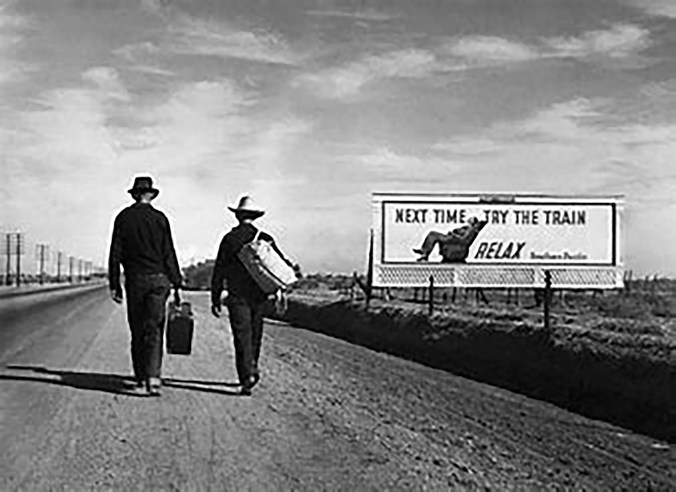
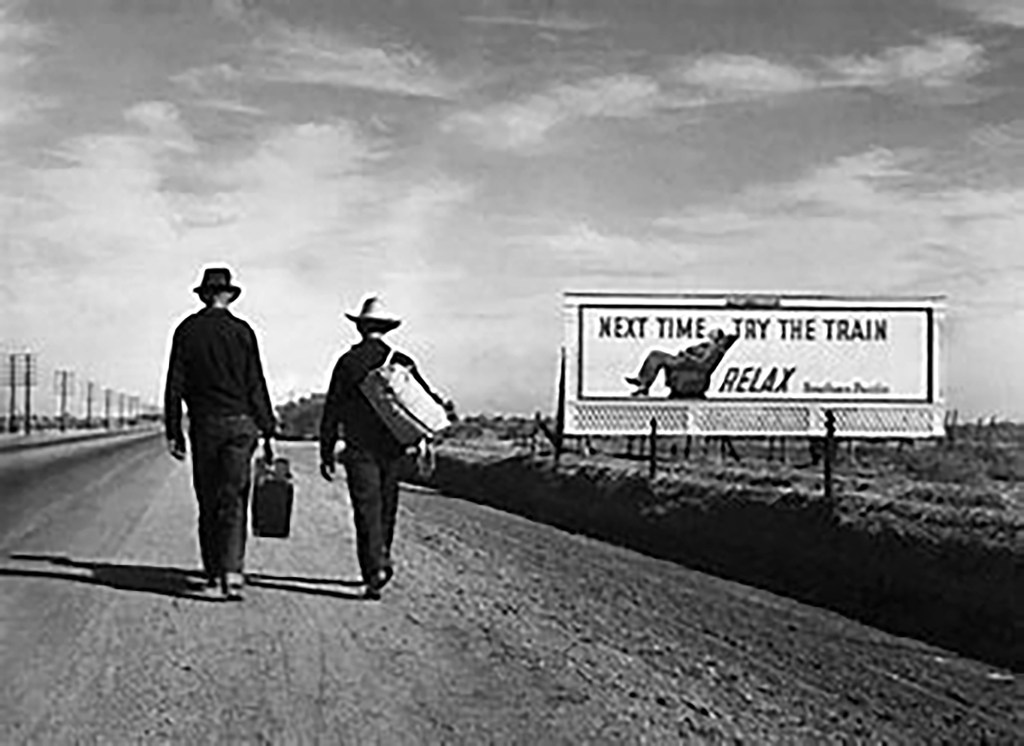
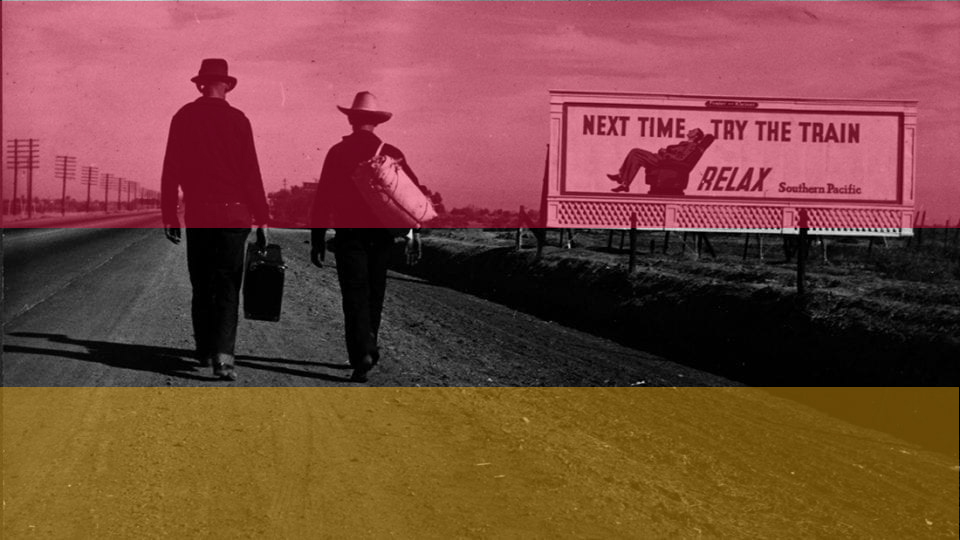
Looking at “Towards Los Angeles” I see two men travelling along a dusty road past a billboard which shows the advertising slogan “Next time try the train……..Relax”. Both men look like they couldn’t afford to take the train. They are walking a dusty road Highway 99 through a dark verge and a line of telegraph poles which form strong leading lines emphasising the distance travelled and the way to go to reach their destination. They are carrying their luggage by hand. Both wear hats shielding them from the sun hinted at with brown necks. The boot of the man on the right is raised making me feel it is a “decisive moment” in the style of Henri Cartier Bresson. Bresson’s photo “Behind the Gare Saint Lazare” (Bresson, 1932) shows the decisive moment of a man leaping across a puddle. The man’s foot is above the water separating him from the physical world it hints at movement in the instant. Neither of the men in Towards Los Angeles appears to be taking any notice of the billboard the punch line of the photograph. As I study this photograph I begin to wonder if it was staged.
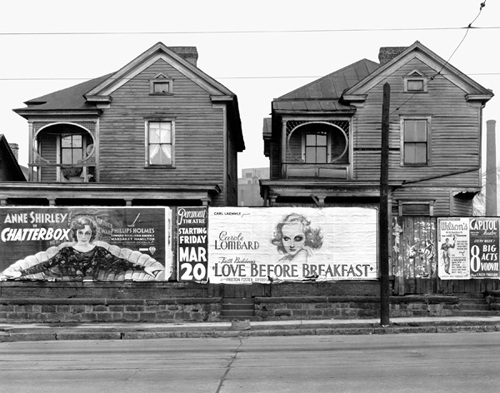
Why include a Billboard? In February 1936 Walker Evans had taken “Framed houses and a billboard” (Evans 1936) followed a year later by Edwin Locke who took “Road sign near Kingwood, West Virginia”, (Locke, 1937). Lange took similar images along route 99 and would have been aware of all of the images taken by Evans and Locke as they were colleagues.
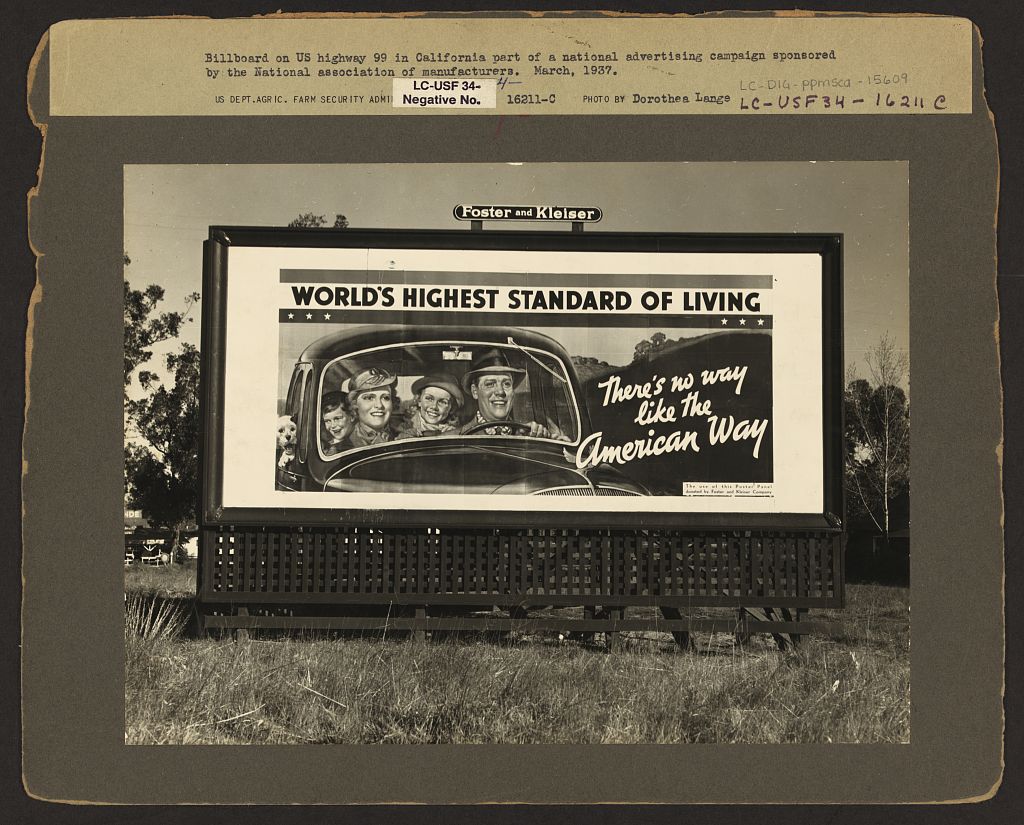
At the same time Margaret Bourke-White was in Kentucky not part of the FSA project. She saw a line of people, displaced by a flood, the people were queuing underneath a billboard she created “Kentucky Flood”, the billboard shows an all American white family with the slogan “Worlds Highest Standard of Living” then a second line stating “there’s no way like the American Way” (Bourke-White, 1937) a truly powerful image as it includes black people, waiting in line for relief from hunger. With a white family enjoy the American dream.
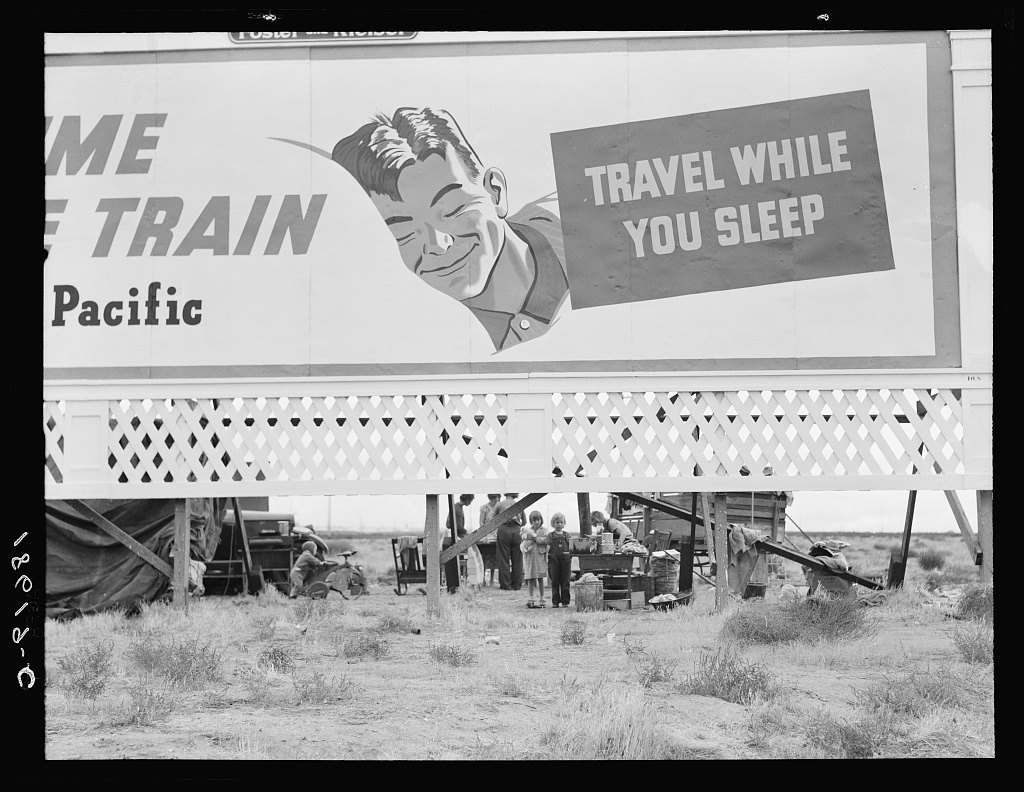
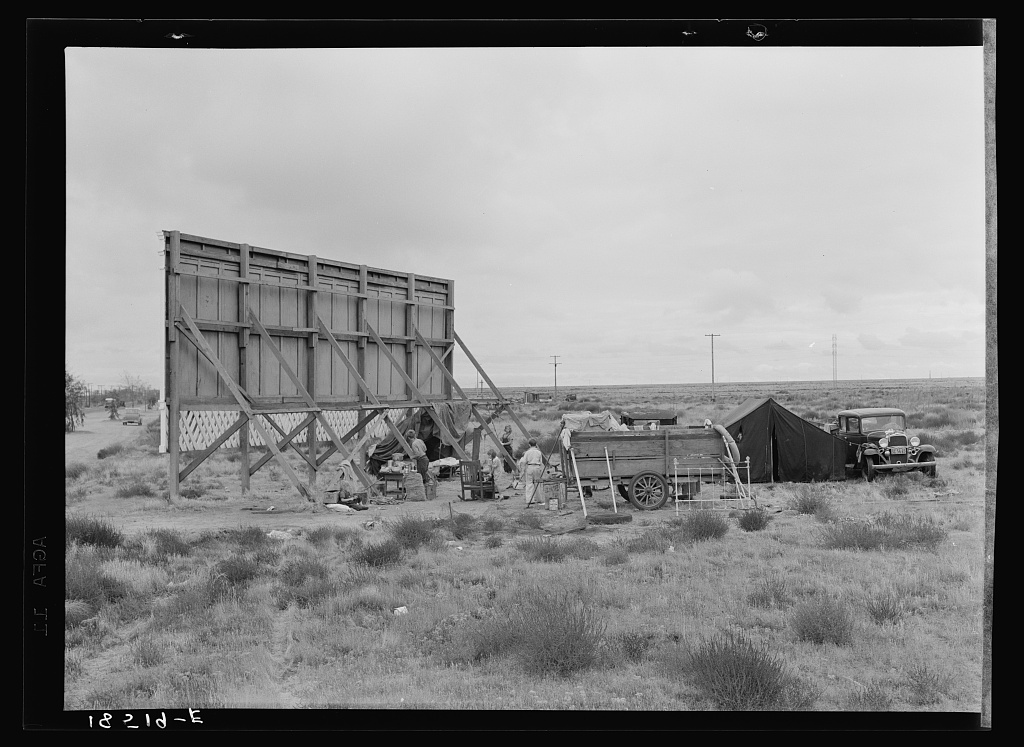
Concurrent to Bourke-White, Lange had been sent to document peoples living conditions along Route 99 in California. It is my interpretation that Lange must have been aware of these photographs as she worked with and was friends with Evans and Locke. Life magazine published “Kentucky Flood”. Around this time she took several shots showing billboards in the landscape but then she made several shots of Pea Pickers using bill boards as shelter. She made “Dispossessed” (Lange, 1937). This photo is less tidy and to me looks like it is a true record of the scene not staged at all.
A little later in the day she made “Towards Los Angeles”. The Billboards in all these exposure are for Southern Pacific Railway but all have different pictures and slogans. None would have been suitable for the two walkers shown in “Towards Los Angeles” as they all had too much of the clutter around the billboard.
Researching this photo took me to the Farm Security Administration. This organisation was formed as part of President Franklin Dwight Roosevelt’s, New Deal. The organisation was tasked with recording the plight of the agricultural population of the United States. Roy Stryker was employed to head the documentary department.
Roy Stryker was an academic specialising in economics. He applied his academic knowledge to his given task. He said “Our editors, I’m afraid, have come to believe that the photograph is an end in itself. They’ve forgotten that the photograph is only the subsidiary, the little brother, of the word” (Stryker, 1936). He realised that photographers with an artistic background would help him gather the images needed to support the written word. He was a firm believer that photographs supported written words and was only part of the truth to be shown.
Stryker had served in the infantry during World War One. This would have given him self discipline and could have been a part of creating his over bearing reputation. In 1964 Lange described his working practices thus “That freedom that there was where you found your own way, without criticism from anyone, was special. That was germane to that project. That’s the thing that is almost impossible to duplicate or find. Roy Stryker…had an instinct for what’s important. Its instinct. And he is a colossal watchdog for his people. If you were on the staff, you were one of his people, and he was a watchdog, and a good one” (Lange, 1964).
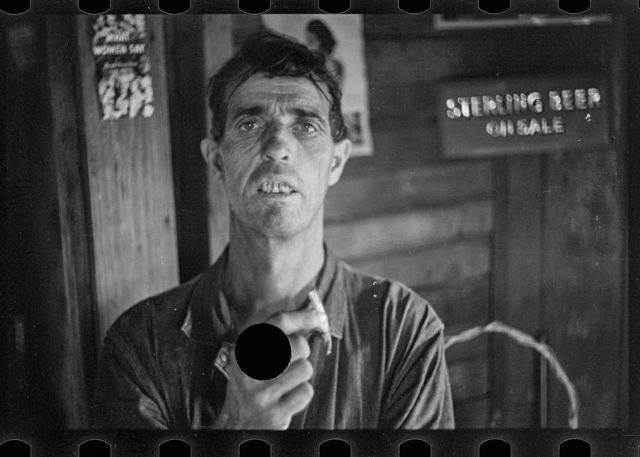
Much of the work I researched spoke about Stryker being a micro manager, who told his team of photographers what to read, where to go, the things to shoot and how to show them. I then found some examples of Stryker and his assistants taking a hole punch to exposures that they felt didn’t meet the brief. I found this shocking. In completing my research I found letters from Stryker (Library of Congress, Various dates) in which he talks about the cost of setting up shoots and questions such small amounts as $5 for travel. He was in control of every detail of his brief, supervising all parts of the work his team produced.
In an interview in 1997 Naomi Rosenblum the author of A History of women photographers (Rosenblum 1994) describes the FSA process “In common with other government agencies that embraced photographic projects, the FSA supplied prints for reproduction in the daily and periodical press. In that project photographers were given shooting scripts from which to work, did not own the negatives, and had no control over how the pictures might be cropped, arranged and captioned. There position was similar to that of photojournalists working for the commercial press – a situation that Evans and Lange found particularly distasteful” (Rosenblum, 1997 336-9).
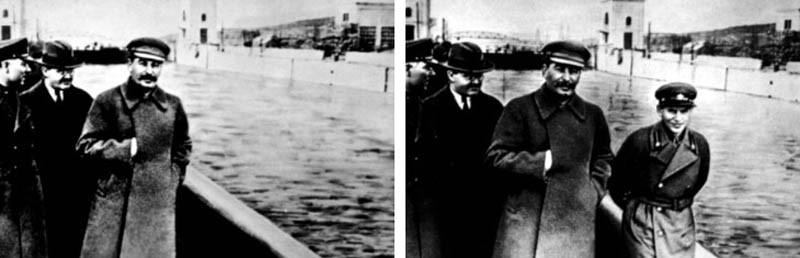
Stryker frowned on manipulation of images evidenced by his reaction when Dorothea Lange removed a floating thumb from “Migrant Mother” (Lange, 1937) Stryker admonished her for doing so. However at this time many famous photographs were manipulated Josef Stalin had Nikolai Yezhov removed from a photograph taken at Moscow Canal (Getty Images, 1934) and Frank Hurley photographer on the Shackleton expedition removed a second boat from the famous “Rescue by the Yelco” (Hurley, 1916) a photograph taken of the crews rescue. He simply scratched the second boat from the negative to add drama. So manipulation was employed long before photoshop (Adobe, 1991).
The FSA produced 164,000 monochrome negatives. 77,000 were made into prints (Library of Congress, 2012). 664 colour prints were produced from 1600c negatives. They featured in the press and in magazines making the cover of Time and Life magazine to show the suffering to all people in the USA. They created a picture of the Great Depression and triggered social changes in both housing and working conditions across the states.
Roy Stryker receives a criticism, I see a man who was educated, focused and understood his brief totally. He also understood he needed to direct his team who were working remotely with little supervision. We live and work in an environment utilizing the internet to give us almost instant reaction to our work. Think of sports photographers they send photos from the stadia direct to their office, getting the image into print or online in seconds. Stryker’s team had to post film into their office taking days to reach Washington. Then the images were processed and a contact sheet would be returned to the practitioner to be captioned and returned. This process would take at least fourteen days. Stryker would need to micromanage this to control it.
Whilst completing my research I found several letters to and from Stryker one of which admonishes the photographer for duplicating the same image five times (Library of Congress, 2012). These negatives would need to be destroyed to save filing space. He also made decisions about exposures whether they were in focus and whether complied with the Governments brief. With 77,000 images to control the process would need to be efficient so the work process could be efficient. I think of my digital library and the issues I experience keeping it clearly catalogued.
All of this begs the question did he trust his team of highly experienced photographers to deliver the photographs he needed to deliver his brief?
I think Stryker trusted his team based on letters (Library of Congress, 2012) he had a tight rein on the shots he wanted from photographer’s who had just started working with the FSA and he gives a free rein to the local organisation to create an itinerary of shots with Dorothea Lange. If she had been given a strict set of instructions I feel Lange wouldn’t have produced “Towards Los Angeles”.
Early in the project Stryker would destroy unwanted exposures with a hole punch. Ben Shahn another FSA photographer said “Roy was a little bit dictatorial in his editing and he ruined quite a number of my pictures, which he stopped doing later. He used to punch a hole through a negative. Some of them were incredibly valuable” (Arbuckle, 2009). Evans and Lange were vociferous from the start about this issue. He listened to the concerns of the photographers stopping this later in the programme. Most of the photographers had protested against the destruction of their images.
In 1942 during WW2 the FSA was incorporated into the Office of War Information. Stryker employed Paul Vanderbilt to catalogue, improve and simplify access to these images. They arranged for the images to enter the Library of Congress, Vanderbilt went with them and continued his cataloguing work. Many would have just walked away job done, Stryker worked to ensure the collection not only was secured but was kept for all to see.
So far I have considered the way the FSA and Stryker organised the brief to gather the shots needed to support this national story. Discussing his dictatorial style, his prescriptive demands could have predisposed the photographers such as Lange to stage their images. If she did would it matter? I don’t think so. Lange had been tasked with showing the gap between the haves and have not’s. This photograph achieves that.
Arthur Rothstein staged some of his scenes for the FSA. Photographs that captured the workers suffering supported the word. Stryker was overbearing, however he recognized his team’s strengths and allowed them some freedom after he had guided them, if they strayed he would not allow the work to progress. He kept tight rein on the purse strings and wanted control of everything from beginning to end. His military background coupled with his academic disciplines gave him the skills to do this. He was the catalyst behind this great project. Without him it would have been quite different, then at the end of the project he ensured its preservation for future generations to view.
This journey has taken me to many stops before I arrived at my destination. Critiquing “Towards Los Angeles” has allowed me to discover the workings of the FSA under Stryker. Without Roy Stryker this collection would probably not exist. We certainly would not have such a concise collection to view and revere.
Bourke-White, M. The Louisville Flood. Art and Artists. Whitney Museum of American Art, New York.
Bresson, H. C. Behind Gare Saint Lazarre. MoMa, San Francisco.
Delano, J. a. (1965, June Puerto Rico). Oral history interview with Jack and Irene Delano, 1965 June 12. (R. Doud, Interviewer)
Evans, W. Houses and Billboards in Atlanta. Art and Artists. Museum of Modern Art, New York.
Hurley, F. Rescue by the tug Yelco. South. London.
Lange, D. Disposessed. Office of War Collection. Library of Congress, Washington.
Lange, D. Migrant Mother. Destitute pea pickers in California. Mother of seven children. Age thirty-two. Nipomo, California. Library of Congress, Washington.
Lange, D. Towards Los Angeles. FSA Photographs. Library of Congress, Washington.
Rosenblum, N. (1994). A History of Women in Photography. New York: Abbeville Press.
Rosenblum, N. (2010). A history of women photographers. In N. Rosenblum, A history of women photographers (pp. 336-339). New York, London and Paris: Abbeville Press.
Southern Pacific Railroad. (1937, March). San Francisco, California, USA.
Unknown. Josef Stalin Group at Moscow Canal. Josef Stalin Great Purge Photo Retouching. Fine art images/Heritage Images/Getty Images and AFP Group, Chicago.
Walther, P. (2008). New Deal Photography. Koln: Taschen.
Walther, P. (2008). New Deal Photography. In P. Walther, New Deal Photography (pp. 18-19). Koln: Taschen. Wells, L. (2015). Photography a critical introduction. London and New York: Routledge, Taylor and Francis Group.
In this review of Dorothea Lange’s “Towards Los Angeles” (Lange 1936) I want to consider the photograph and look at its structure, context and its meaning. Why did she take it? What does it say? Finishing with how the photograph sits within the Farm Security Administrations work.
The photograph was taken in February 1936 during the Great Depression in the United States. It is a Silver Gelatin Print taken during her work around El Monte and San Fernando, California for the Farm Service Agency (FSA). It is taken on the road to Los Angeles.
The work is a landscape with a billboard and two men walking along a road lined with telegraph poles. The both carry luggage. The man on the left is carrying a suitcase in his left hand whilst the man on the right is carrying a canvass holdall on his right shoulder. They both look like Cowboys or at least farm hands. The luggage they carry looks to be in good condition and the clothes they are wearing appear to be in good order. The left mans right shoulder is drooping due to the weight of his luggage.
Both men`s necks and hands are visible and look well tanned from hard days working on the land that this road snakes across. Their feet are in different stages of walking the right mans left foot is off the ground and the man on the left has is right foot raised off the ground in a purposeful march into the future.
The road they are walking on is a tarmac road with a dusty verge and they are walking with the billboard to their right. The bill board says “Next time try the train”, with a line underneath that states “RELAX” accompanied by the name of the railroad placing the advert “Southern Pacific”. Underneath the billboard there is a trellis to finish off the billboard but it adds a new texture to the picture.
From the left edge of the picture run telegraph poles at least ten in number run along the verge of the road. On the right side a series of fence posts runs between the men and the billboard forming a barrier between the longed for better life and the walk. The surface of the dusty verge is indented with the treads of the cars which have pulled over off the tarmac for unknown purposes.
The billboard appears to be on land between the fence and open farmland the type of land these men are leaving. There is a second less prominent fence behind the billboard which emphasises the lead line it forms.
The sky makes me think it is blue and peppered with wispy clouds being blown into majestic lines which luckily add to the lead lines in the rest of the picture. It is a bright sunny day with little wind on a dry dusty day.
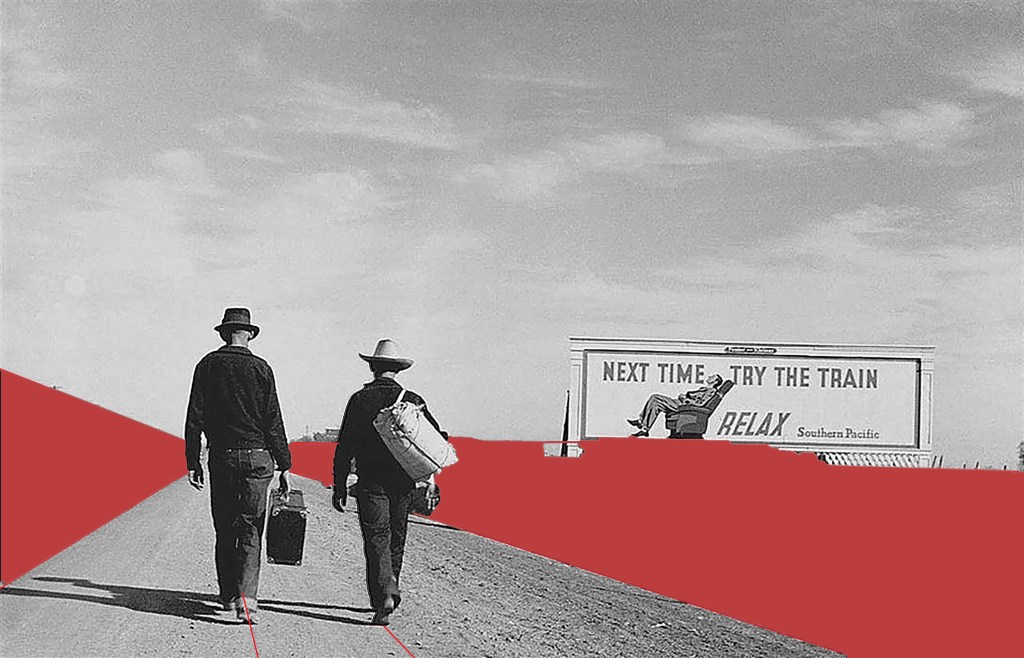
The line of telegraph poles and the fences form a great lead line into the picture and give it feel of great perspective emphasising the distance these men have yet to travel. The billboard makes a statement just in its presence. The lines of perspective are added to by the tire tracks and even the clouds being blown into shape in the air. The right hand verge adds a shadow which breaks up the photo and adds the strongest lead line in the photograph.
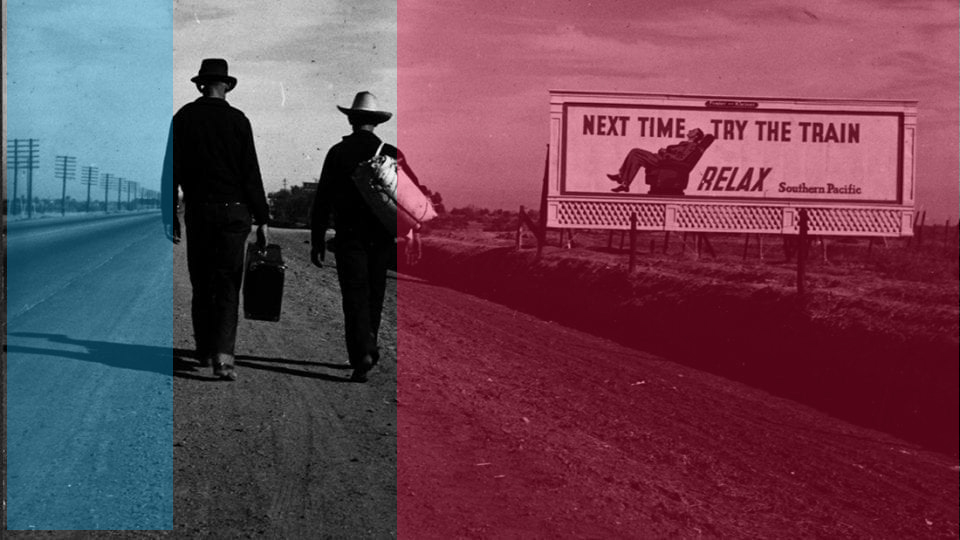
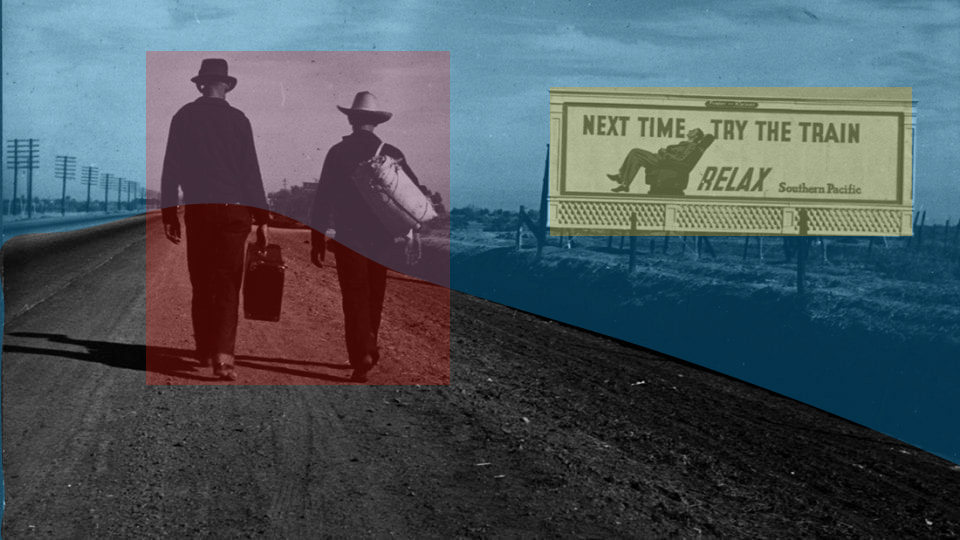
The photo whilst having these strong lead lines also follows the rules of thirds if you draw a line through the left shoulder of the left man from top to bottom you get the space for the telegraph poles, Do the same through the right shoulder of the man on the right you get a space for the men with a third segment for the billboard.
It also follows this rule horizontally the line of the horizon gives a large empty space, secondly a line across the picture level with the soles of the feet has all the detail in it. Finally the lower space has the tarmac road and the dusty verge forming a second empty space.
The last observation I make looking at the photograph is that the men are taking no notice of the billboard they seem to be just focused on the task in hand the journey through this landscape to a hoped for better future.
Within the frame I see a triangle formed with the perspective of the road between the verge and the telegraph poles. Then two rectangles one is the obvious one in the billboard, the second one is formed by the sky. Finally is see a square around the two men walking?
At first glance the picture appears balanced and almost flat. However look further and you see the perspective formed by all the lines. Then the Billboard throws the picture out of balance and you see the writing this begins the questions and made me laugh when I read the words. Then men then throw the picture back into balance with all the action in the middle section.
The contrast is uniform in most of the picture, one element the dark verge to the right emphasises this lead line and takes you into the picture to the billboard.
Feet walking into the scene give a sense of movement and hint at the long journey being completed. The lead lines emphasise this journey adding a sense that this walk is to be a long one which alternatively could be made by rail. The lines guide you into the photo and to the billboard. The sky and the land show that this is big country. Telegraph poles disappearing are the last element giving a sense of distance yet to travel.
My eye goes to the centre of the photo to begin with but this area is empty between the men and the board. Sometimes my eye goes left to the men and sometimes to the right to the billboard. My eye does this as the two main subjects are balanced on the central line. Then my eye looks at the telegraph poles and gets the sense of distance. The two men are darker than the rest of the photo so stand out due to their darkness. Then the board stands out because it is brighter than the men.
This photo is unusual as Lange usually takes photographs showing serious scenes. This has satire and subtle humour whilst still having a serious message. Shadows leading from the men’s feet hint that it is late in the day and they have already travelled far whilst having far to go. Reclining on a seat a man has an easy time travelling this same route whilst our two heroes have to suffer a long walk.
This work was created to document the suffering of the workers in the USA caused by the Great Depression. The failure of the crops coupled with banks foreclosing on loans led to mass migration of people across the USA. This is summed up in one simple shot. In a fraction of a second Lange has caught the migration of agricultural workers who can’t even afford a rail ticket. She has then presented it with humour showing how these people just got up and got on with it. What choice did they have?
When I was completing my research I watched a film in which Dorothea Lange and John Swarkowski use on of Lange’s favourite sayings “Grab a hunk of lightning” she certainly did that here.
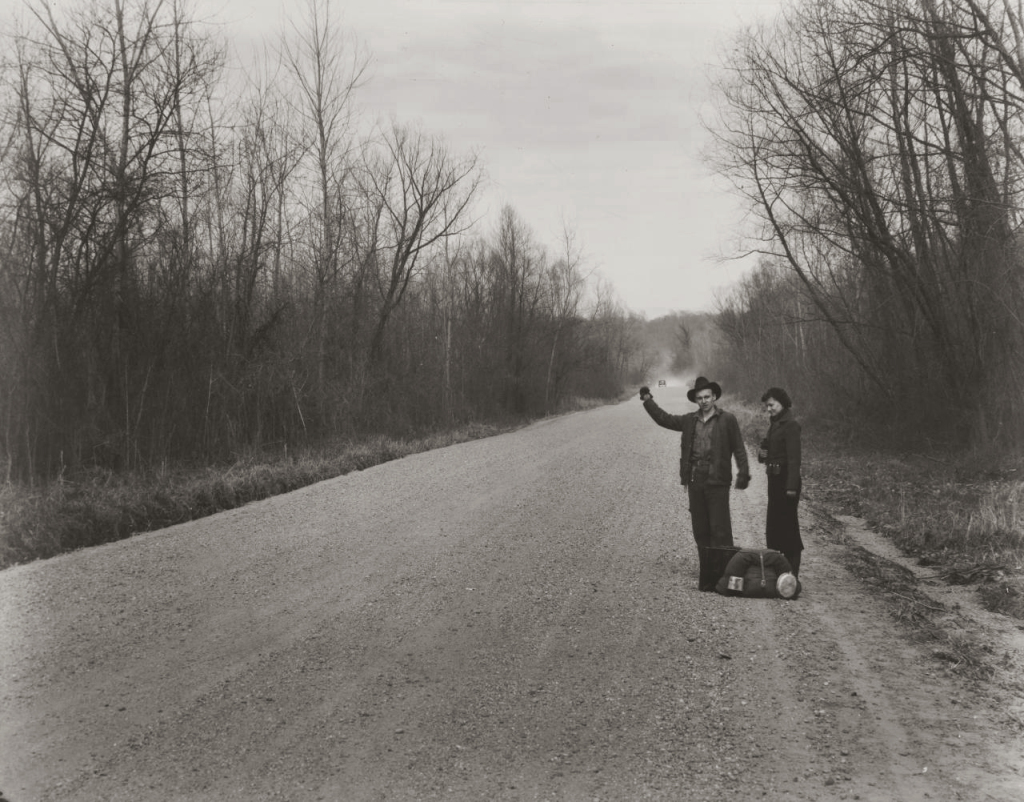
I find this work rewarding to look at, “Always look on the bright side of life” (Idle 1980) comes to mind when I see this photograph. These men are walking to a hoped for brighter future. I see the same thing in Walker Evans photograph “Hitch hikers near Vicksburg Mississippi” (Evans 1935), however Lange has added the billboard in her shot, this added element makes it more palatable but takes nothing away from the serious message.
This photograph has travelled well through the 80 years since it was taken. We have migrants across the world moving to find better futures for their families caused by financial institution and governmental mistakes. Different times same mistakes.
Looking at this exposure gives me a sense of hope for the future whilst dreading the past left behind. I wonder if these two men have left families behind who will join them once new hopeful lives have been created. Much like when I see the male refugees arriving on the shores of Europe today.
This work is poignant, funny, striking, timeless and disturbing all at the same time. It is a beautiful, simple depiction of an ugly subject. Much like some of the work we see in the media capturing the hope people have when they suffer indignities to get to a Promised Land.
This work is a huge success it makes me think. I want to know the stories behind the footsteps and I want to find out where the steps into the unknown led these two men. I want to understand what led to this Hunk of Lightning. If I had seen the photo at the time it was taken I would have spent time to find out all I could and would be doing all I could to help. Whether it is beautiful or ugly is unimportant it is a success because it makes me care.
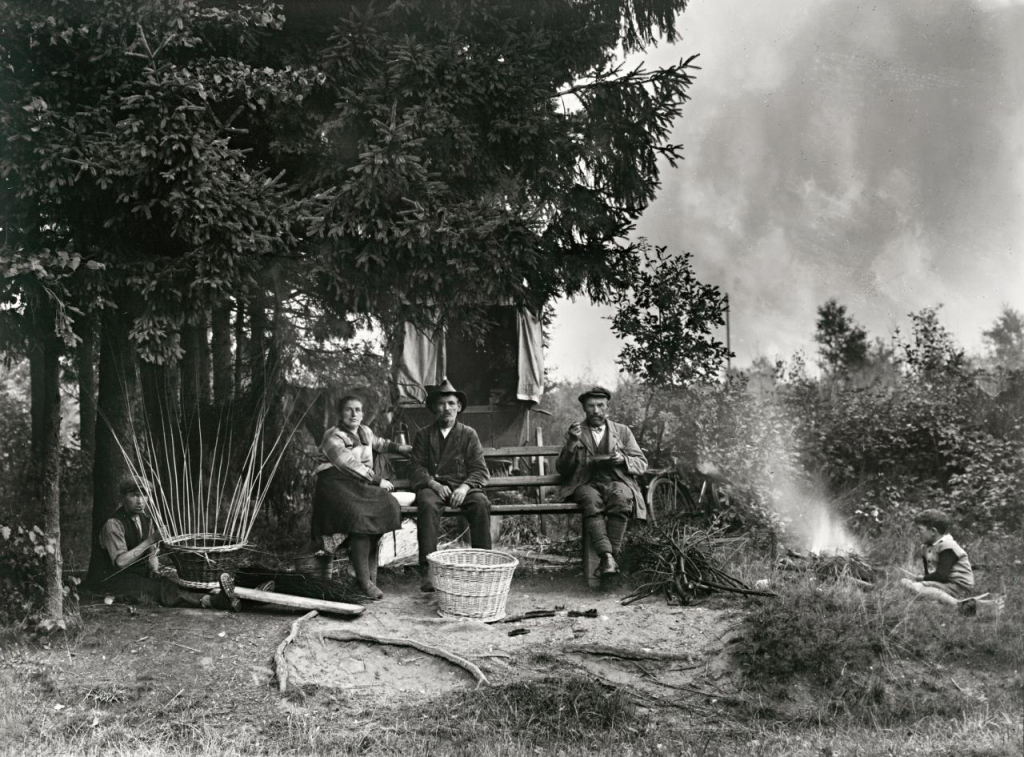
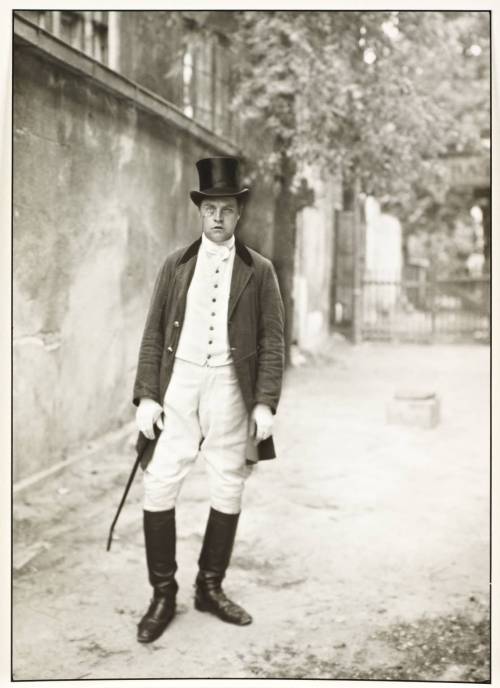
On first seeing this photograph I thought it was original, doing my research though led me to several examples where a similar scene was shown. August Sander shows a similar scene with “Itinerant Basket Weavers (Sander, 1929) as does Walker Evans in “Hitchhikers near Vicksburg Mississippi” (Evans, 1939). The difference is the billboard this adds a memorable element, at first funny then thought provoking. Interesting that Lange and Evans knew each other and took similar shots of the same subject in the same year did they compare and discuss their work?
August Sander Itinerant Basket Weavers 1929.
Walker Evans Hitchikers near Vicksburg Mississippi 1939.
Dorothea Lange used her camera well by understanding her brief from the FSA and applying it to what was on the road to tell the story, however she used her number one and number two instruments exquisitely, her eye and her brain. She will have had moments to see and set up this shot, she did it superbly.
In looking at this exposure I began by critiquing it as a photograph but have ended relishing it for the mood it creates. It captures the situation these people were forced into then shows the spirit of these two humans in dealing with their situation. Lange then shows us some humour and we empathise with these two men. We all enjoy a little humour even dark humour in times of trouble.
These individuals are going on a journey together, I am going with them. More than this I want to get involved not just with these individuals but with the struggle the farmers are suffering. Some critics of photography have pointed out that “privileged people” use their cameras to look down on poor subjects. I believe this work and others like it encourage us to find out more, when other organisations may not want us to see it at all.
Writing this review made me think of a lyric in the song “Walking down Madison” (McColl, Marr, 1982) that says “From the sharks in the penthouse to rats in the basement, it’s not that far”, making me think how precarious all our lives are. It doesn’t take much to put me on a journey to a new place to find a new future…….scary.
All this from one photograph that at the outset looked like a simple, slightly humorous shot. If you set out with an interest and have an open mind it is amazing where these practitioners can take us.
“Compassion is an unstable emotion. It needs to be translated into action, or it withers. The question of what to do with the feelings that have been aroused, the knowledge that has been communicated. If one feels that there is nothing ‘we’ can do — but who is that ‘we’? — and nothing ‘they’ can do either — and who are ‘they’ — then one starts to get bored, cynical, apathetic.” (Sontag, 1964).
We must not be apathetic.
Works Cited
Evans, Walker. Hitch hikers near Vicksburg Mississippi. FSA, San Francisco.
Grab a hunk of lightning. Directed by Dyanna Taylor. Performed by Dorothea Lange. 2014.
Lange, Dorothea. Towards Los Angeles. MoMA, Chicago.
Maccoll, Kirsty. Walking down Madison. Comp. Kirsty Maccoll and Jonny Marr. 1982.
Python, Monty. Always look on the brightside of life. Comp. Eric Idle. 1979.
Sander, August. Itinerant Basket Weavers. National Gallery of Victoria, Victoria.
Sontag, Susan. “On Photography.” In On Photography, by Susan Sontag. New York: Penguin, 1978.
Below is the feedback I recieved from my tutor in regard to my critical review for Assignment 4. Since my feedback I have signed up and completed work with the Royal Literary Fund. This has started my journey towards mastering the skill of writing in an academic way.
I have begun to read Umberto Eco “How to write a thesis” and have read “Cite them rite”.
I have also completed an online course in Japanese Stab Binding and have ordered the materials and the tools to make a photobook with the control over the whole process.
In this research I will look at Towards Los Angeles a photograph by Dorothea Lange taken in the great depression in the USA. Before I critique this photograph I would like to discuss the journey the artist took to get to the point of taking this photo.
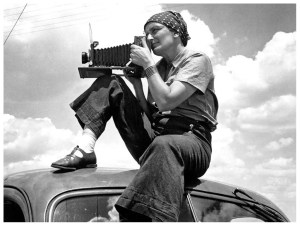
Dorothea Lane was born on the 26th of May 1895 in Hoboken New York her birth name was Dorothea Margareta Nutzhorn her parents were of German dissent and were named Heinrich Nutzhorn and her mother Johanna Lange. In 1907 her father abandoned the family who were completed by a boy, Martin. When this happened Dorothea dropped her middle name and took her mother’s surname becoming Dorothea Lange.
At age seven she contracted polio and while many would see this as a handicap Dorothea embraced it saying “It formed me, guided me, instructed me, helped me and humiliated me. (Lange, 1998)” After graduating from school she attended Columbia University where she was tutored by Clarence H. White. Leaving university she worked in several of the best photographic studios in New York.
Her wanderlust took her on a trip with her friend they planned to see the world but were robbed in San Francisco so they settled there. She worked in photo studios meeting several influential people who helped her set up a successful studio taking photos of the wealthy. In 1920 she married Maynard Dixon and over the next ten years had two sons.
During this period she completed several projects one being of the unemployed and homeless. She by chance took an exposure at the soup kitchen run by a widow nicknamed “The White Widow” (Lange, 1936). This photo naturally had the title “White Angel Breadline” (Lange, 1936). It was liked locally by influential practitioners’ and it led to work with the Resettlement Administration (RA) the forerunner of the Farm Security Administration (FSA).
FSA Logo (1936)
During 1935 she divorced Dixon and married the economist Paul Schuster Taylor. Taylor was a Professor of Economics at the University of Berkeley. They went onto record the poverty around the area where they lived. Taylor wrote pieces about the families encountered while Dorothea photographed them.
Towards Los Angeles Dorothea Lange 1937
Working for the FSA allowed her to capture some of the most important photos of the time. “Migrant Mother” (Lange, 1937) is one of the most revered images of all time and was taken around the same time as “Towards Los Angeles.” (Lange, 1937) Many of her photos were printed by the “San Francisco News”, when they supported John Steinbeck’s work “The Harvest Gypsies” (Steinbeck, 1936), a collection of articles about the farmers suffering the depression supported by images including “Migrant Mother”.
John Steinbeck Pamphlet Harvest Gypsies 1938.
Her next big piece of work was documenting the lives of interred Japanese-Americans; this work was carried out for the War Relocation Authority. She applied herself to the plight of these people so well that the government wouldn’t let them be seen. They didn’t want any sympathy for the Japanese citizens.
In 1945 Ansell Adams asked Dorothea to teach at California School of Fine Arts. Their friend Imogen Cunninham from Group f.64 joined at the same time.
Life Magazine Logo
She Co-founded the magazine LIFE in 1952 and Dorothea did several pieces of work for this magazine including the damming of Berryessa and its effect on the residents. Again she documented the suffering warts and all.
Then in 1952 Dorothea Co-founded Aperture Magazine which is still in print today she had been familiar with Group f.64 and the magazine this group produced called “Camera Craft” (Lange, 1935).
Apperture Magazine Logo
John Szarkowski displayed her work at the MoMA between 26th January and 10th April 1966. He couldn’t believe the collection of work she held at home and how well they were indexed. She worked tirelessly even though her health was now failing.
From about this time until her death in San Francisco her health suffered. She died from Cancer on October 11th 1965. She must be remembered for her favourite saying “Grab a Hunk of Lightning”.
Susan Sontag (Sontag, 1979) says about privileged photographers hanging around the oppressed and even looking down on people. “Social misery has inspired the comfortably off with the urge to take photographs”. Susan Sontag On Photography ISBN 978-0-141-037678-9 Page 55 Par 1 Line 8. I don’t feel this with Lange. I see someone who wanted to tell the story visually whilst improving the lives of the people photographed and the ones who were not.
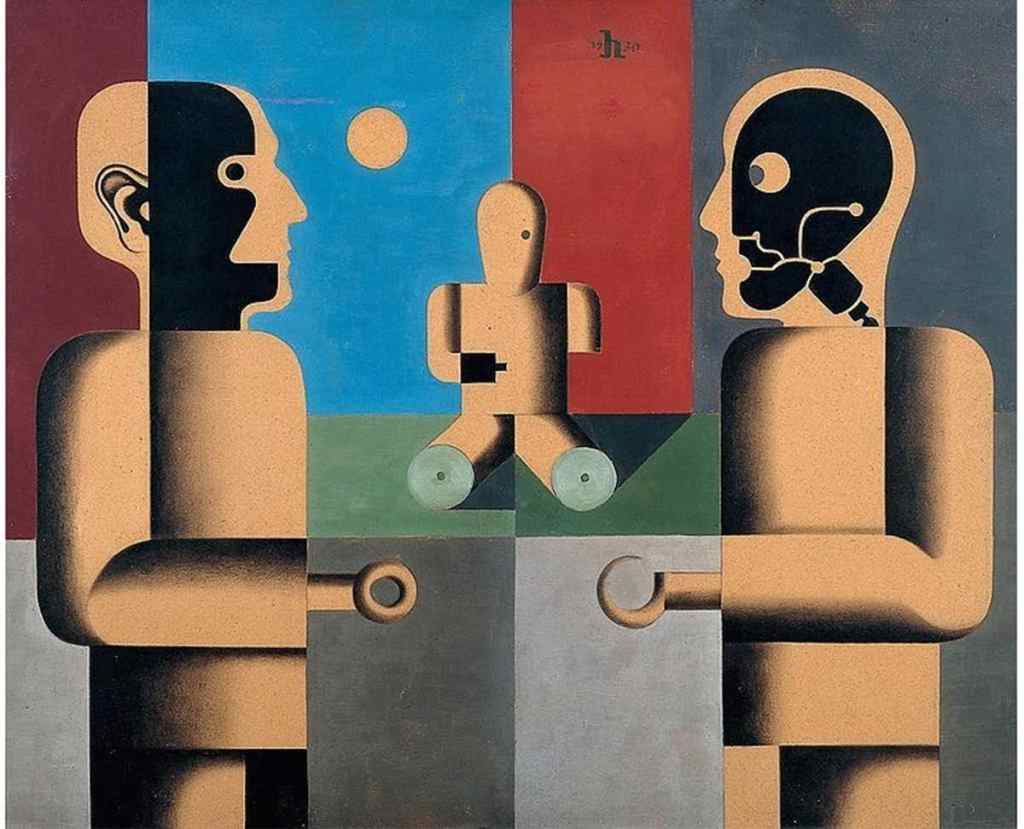
In it he discusses the returning German casualties being fitted with Prosthetic limbs. The Red Cross produced a book entitled “Reconstructing a man” in 1918. It acknowledges the fact that thousands of men were returning home and being “repaired” in fact made better than their pre-war selves by being fitted with prosthetic limbs. They even termed them “Homo Prostheticus”. These “Robots” could complete their work more efficiently than they could have before the war. Could this have been a driver for Sander to record the normal people who did these tasks less efficiently as well as recording the disappearing people pre metropolis? Was he afraid they would be taken over by man machines, and then later he may have seen the war coming with more “Homo Prostheticus” men to flood the county?
Heinrich Hoerle painted “Monument of the Unknown Prostheses’ (Denkmal der unbekannten Prothesen, 1930)”. To show how man had returned and being fitted with prosthetic limbs and had become an uber efficient machine a “better” version of himself. Hoerle wanted to questions this pointing to the anguish these individuals suffered due to their injuries. They were not “Uber Menschen” but victims of war injuries.
Heinrich Hoerle “Monument of the Unknown Prostheses’ (Denkmal der unbekannten Prothesen, 1930)”.
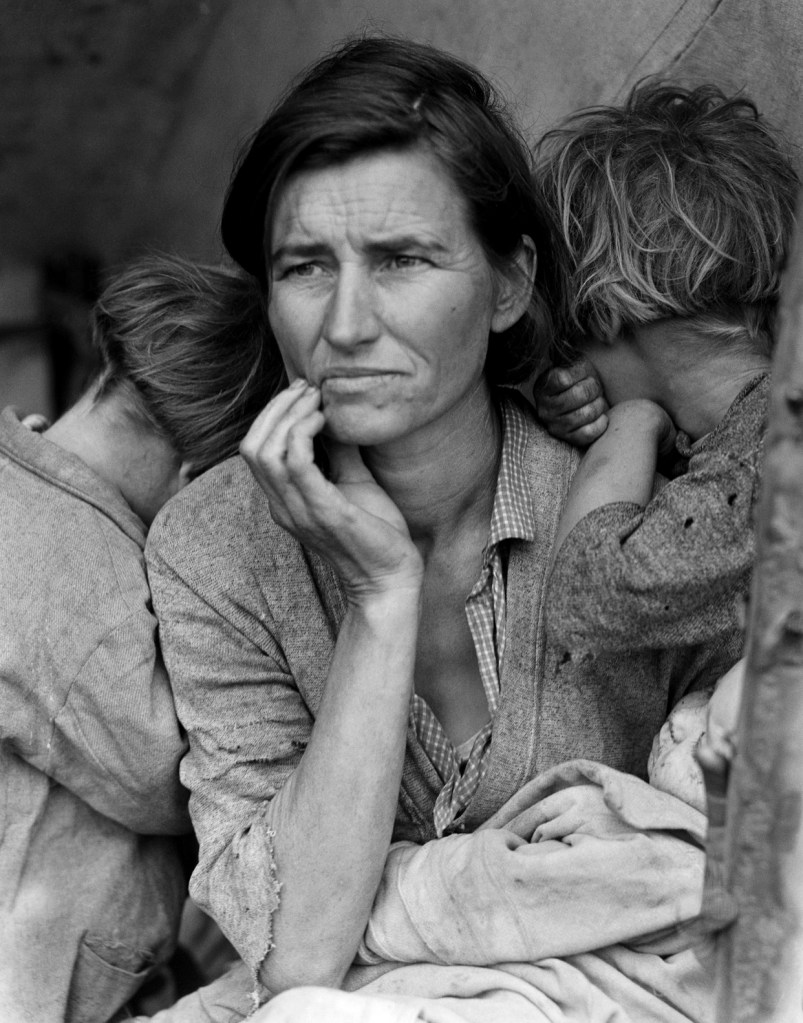
The photographers working for the FSA were doing much the same work. Sent out into the landscape to document the suffering of those people living on the land. These people were injured by the Great Depression and their injuries were mental, but just as damaging as losing a limb. You can see the mental anguish in the photograph “Migrant Mother” (Lange, 1936). Dorothea Lange captures it perfectly you can see the vulnerability of this woman at the same time seeing her pride, fear and concern for her offspring all in equal measure.
Migrant Mother (Lange, 1937).
In the “Great Depression” Franklin D Roosevelt set up several administrations to help show the state of the nation. Then to suggest and document any improvements carried out to improve the situation in the nation. One of these administrations was the Farm Security Administration (FSA).
The man placed in charge of the FSA was Roy Stryker. He was an academic and a man who had served in the US Infantry in World War One. He was disciplined and intelligent so had the right characteristics to complete this huge task. He thought photography was excellent at supporting the written word so employed 13 proven photographers (Dorothea Lange, Arthur Rothstein, Walker Evans, Ben Shahn, John Vachon, Marion Post-Walcott, Russell Lee, Jack Delano, Gordon Parks, John Collier, Carl Mydans, Edwin Rosskam and Louise Rosskam) to capture images across the USA. At the end of the FSA work in 1942 when the FSA was incorporated into the Office of War Information Stryker used all of his discipline to catalogue and archive these exposures including many of the ones with holes punched in them. He was assisted by
This project was a huge undertaking and he would have needed all of his military experience of logistical organization coupled with his knowledge of the US to send these few out into the field to capture the images. He was dictatorial in his approach, giving exposure lists to each of the photographers. Some as detailed as “A white house, with a white fence”, He wouldn’t let the photographers stray from his scripts.
When the negatives came in to his office in Washington he would review each one and any Stryker didn’t like or were out of focus or off topic would be destroyed with a hole punch. Most of the photographers were dismayed to see their work treat in this manner and complained to Stryker. Later in the project he relaxed this practice.
Photo showing a hole punched in it (LoC, 1937).
I found it interesting to consider the time scale for each part of the project exposures were made then posted into Washington, Stryker reviewed and printed them and sent them back to be captioned then they were returned to the office for use. This could take two or three weeks. Lange kept detailed notes of what was said by her subjects so she could caption the photos, often with the words the subjects had spoken. These are all kept and shown in the Library of Congress in Washington and are available to all online.
The FSA created 77,000 negatives including 644 in colour they are a record of the conditions agricultural workers were enduring trying to support themselves and their families. Most are regular shots fulfilling Stryker’s lists but some are moving and works of art. I do wonder as I look at Towards Los Angeles if it was staged and looked at examples from before this time where photographs had been manipulated to understand how far photographers and organizations would go to put across a theme.
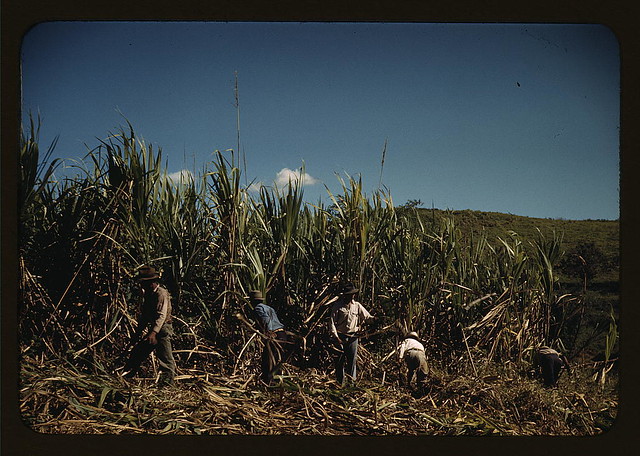
Farm Labourers in Sugar Cane Jack Delano 1941.
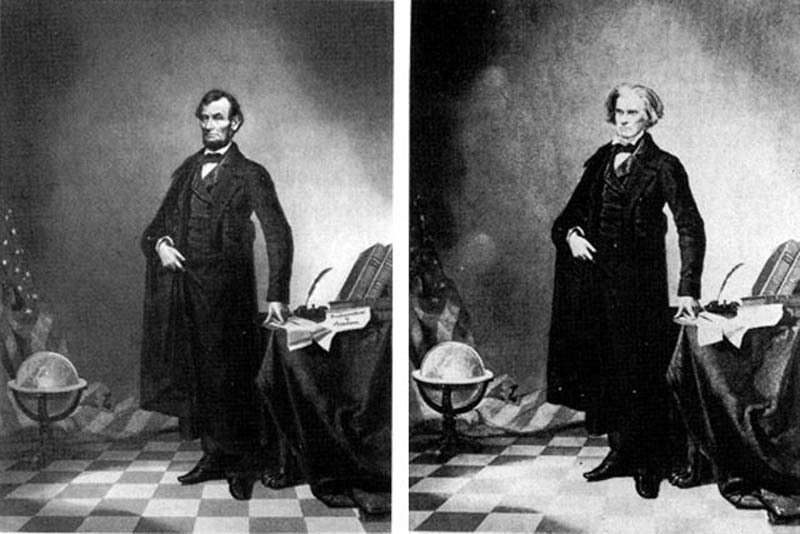
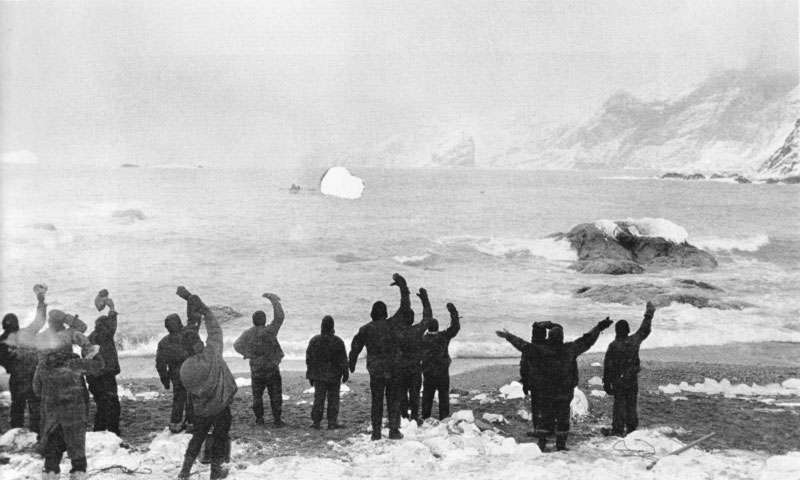
Joseph Stalin had people removed from photographs as they fell out of favour. One shows a young commissar stood in a group by a river he must have fallen from grace because in later versions he is missing. Frank Hurley who was the photographer on Shackleton`s ill fated expedition recorded all aspects of the journey, but in the rescue photo only one lifeboat rows to shore, he had scratched out the other to make the exposure more dramatic. He had manipulated earlier photos to create his postcard business in Australia. Even Abraham Lincoln had featured in a manipulated negative when his head was imposed on John Calhoun’s body to make a well-used image. So well before Lange took Towards Los Angeles images were being altered to project a message.
Lincolns head on Calhouns body
Scratched out boat
Missing Comissar
I can find no evidence for Lange having manipulated the exposure and do not think she would do so. However the photo does look as if some staging may have been employed. The fact it is so perfectly aligned to the rule of 3rds both in the horizontal and the vertical. The timing of the steps almost too perfect a decisive moment. The tracks in the dust on the road verge suggests someone pulling over and discussing the staging. Does it matter if it was staged?
I considered the billboard in Lange’s photo and wondered if others had used them before her. I found that Walker Evans had shown billboards in “Billboards and houses in Atlanta 1936 (Evans, 1936). Lange was a colleague and friend of Evans so would have been aware of this shot. Then I found “Kentucky Flood” (Bourke-White, 1937) a photo, which depicts a group of people queuing for relief in front of a billboard with an all-American family driving a car under the slogan “Worlds highest standard of living”. This was taken just weeks before Lange took “Towards Los Angeles”. She would also have been aware of this image as it was featured across the press and was the cover of “Life” magazine. Evans earlier shot showed just billboards whilst Bourke-Whites image combined people with the billboard making a powerful image.
Kentucky Flood 1937
Kentucky Flood 1937
Pea Pickers behind billboard Lange 1937
Pea Pickers shelter Lange 1937
Billboard Route 99 1937
This research should enable me to review Lange’s photo and possibly expand further work describing the FSA and all that it achieved.
Bourke-White, Margaret. “The Kentucky Flood.” Whitney Museum of American Art. Art and Artists. New York.
Delano, Jack. “Farm Labourers in a sugar can field”. Library of Congress. Washington 1941.
Evans, Wlaker. “Houses and Billboards in Atlanta.” Museum of Modern Art. Art and Artists. New York, 1936.
Hoerle, Heinrich. Monument of the Unknown Prostheses. Berlin Museum of Art, Berlin.
Lange, Dorothea. Camera Craft. Camera Craft, 1935.
Grab a hunk of lightning. Directed by Dyanna Taylor. Performed by Dorothea Lange. 2014.
Lange, Dorothea. “Migrant Mother.” Library of Congress. Destitute pea pickers in California. Mother of seven children. Age thirty-two. Nipomo, California. Washington, 1936.
Lange, Dorothea. “The White Angell Bread Line.” MoMA. Chicago. 1936.
Lange, Dorothea. The White Widow. MoMA, Chicago.
“Library of Congress.” Washington USA: Library of Congress, 2020.






 Michael Green Landscape Studies